
Updated ,first published
You have reached your maximum number of saved items.
Remove items from your saved list to add more.
Save this article for later
Add articles to your saved list and come back to them anytime.
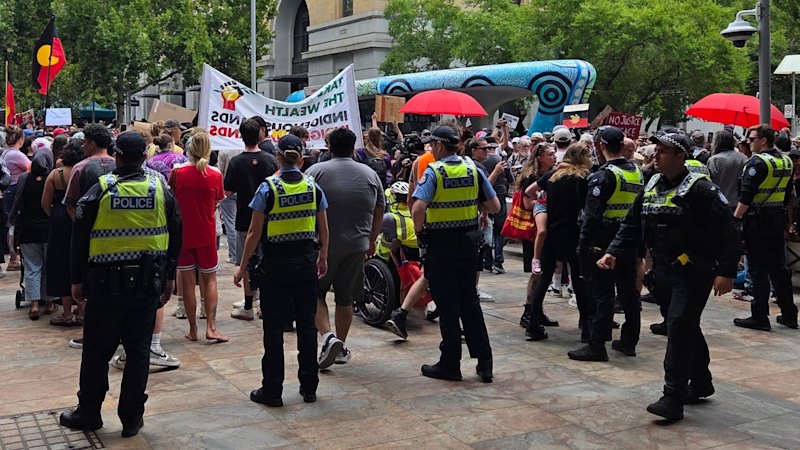
West Australian police have defended the actions of their officers after facing criticism for their response to an alleged attempted bombing at the Invasion Day rally in Perth’s CBD on Monday.
A 31-year-old man from Perth’s north, who cannot be named for legal reasons, appeared in court on Tuesday accused of making and throwing the explosive into the crowd at a rally protesting WA’s Australia Day celebrations.
Thousands of people gathered in Forrest Place in Perth’s city centre to attend the event, which had to be evacuated after a member of the public told an attending police officer something had been thrown into the crowd.
But organisers criticised WA Police for a lack of communication when they became of aware of the threat, alleging they created confusion and “unnecessary concern”.
Rally organiser Fabian Yarran said police needed to investigate further charges against the man, and claimed the investigation following the event had been lacklustre.
“The police, government and media response in the 24 hours following the incident has been inadequate, consisting solely of investigations and charges for less serious, non-terror and non-hate offences,” he said.
However, a WA Police spokesperson said officers had been placed in a difficult position on Monday, and had to prioritise public safety.
“The Western Australia Police force’s decision to evacuate Forrest Place during the Invasion Day rally was made in response to a potential mass casualty threat,” they said.
“A decision had been made to deploy significant police resources to the area prior to the event, in case protest participants required protection from a range of possible scenarios including the critical incident which actually took place on the day.”
Yarran previously said the Invasion Day rally had attracted several serious threats in the lead-up.
“The police response balanced an urgent need to evacuate but also a need to stop a level of panic which may have in itself resulted in serious injury through crowd crush,” the WA Police spokesperson said.
WA Police said Col Blanch and Mechelle Turvey, the mother of murdered Indigenous teen Cassius Turvey and head of the agency’s Aboriginal Affairs division, met with elders on Wednesday to reassure them they respected the right to protest.
Yarran has also criticised police for failing to take the necessary steps to name the incident as an act of terror.
“This incident must be fully investigated as an act of terrorism and a hate crime against First Nations people and protesters, and appropriately charged as such,” he said.
Yarran called for the recently announced royal commission into antisemitism to be expanded to target all forms of racism, and in particular, the rise of the far-right movement in Australia.
His concerns were echoed by national anti-racist organisation Democracy in Colour national director Noura Mansour, who said what had been alleged should amount to a hate crime.
“What we saw in Perth was a calculated attempt to cause mass harm to First Nations people and their supporters and should not be downplayed by the media and authorities,” she said.
“To treat this as a simple criminal matter rather than a targeted act of hate is a slap in the face to the communities living under the threat of far-right violence.”
WA Defence Issues Minister Paul Papalia on Wednesday said labelling the incident an act of terror required confirmation of motivations, and “I’m not sure that [police] understand the motivations behind this individual at the moment”.
Papalia said he believed police, facing a big crowd that wasn’t fully aware of the reasons the rally was being cleared, handled the “tense situation” well.
“In my view, there has been some very ill-informed commentary from peripheral political players,” he said.
“They don’t know what they’re talking about, and they should be more responsible.”
Australian National University terrorism researcher Dr Michael Zekulin said the decision to call something an “act of terror” by WA Police or federal authorities would ultimately come when investigators were able to determine the man’s main alleged motivation.
“Specifically whether an incident is being done for ‘personal’ reasons or if there is a broader political, ideological goal,” he said.
“Trying to determine the underlying motivation for an action taken by an individual can be difficult.”
In court on Tuesday, the man successfully applied to have his identity suppressed to protect his safety.
“In these circumstances it could be seen that a class of people may have been the target of the offending,” his duty lawyer Maddison Darch said.
“If [the man] was to be identified as the person who is accused of these allegations, his safety in a custodial environment would be in jeopardy.”
Darch told the court the man would be at risk both in prison and in the community if his name was known, and his family were also concerned they could be linked to his alleged offending.
It is understood WA Police are currently investigating whether the man accused of throwing the bomb had come to their or federal authorities’ attention previously.
You have reached your maximum number of saved items.
Remove items from your saved list to add more.