
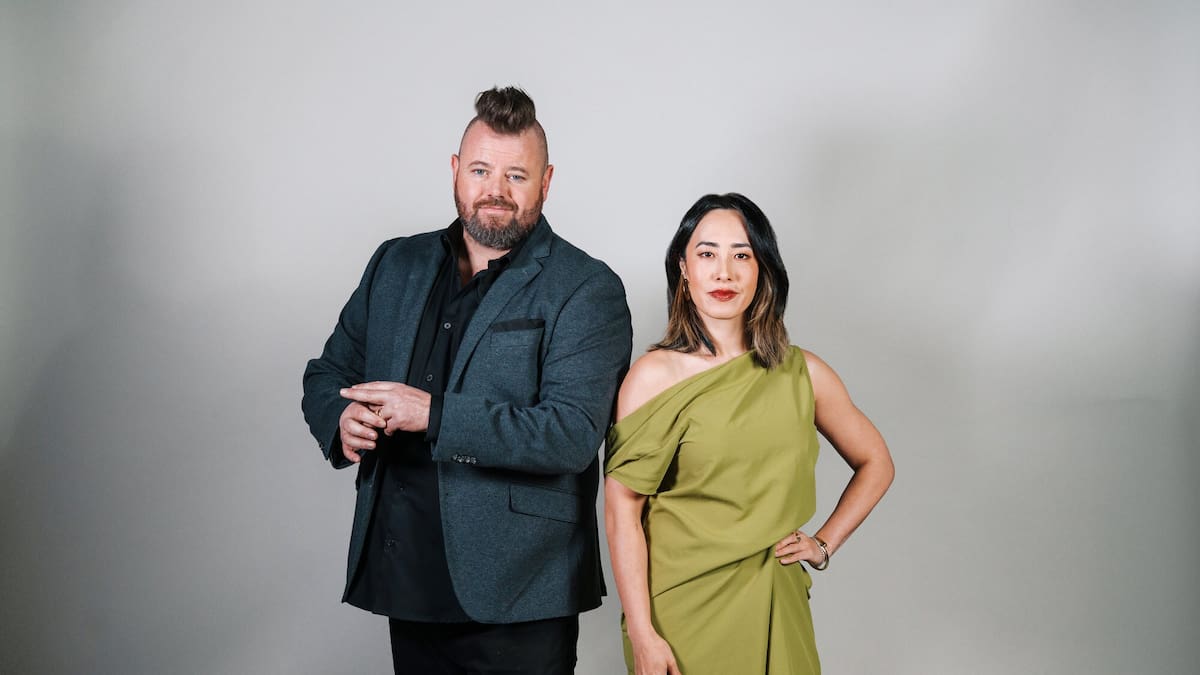
Leong (Dessert Masters and ex-MasterChef Australia) shares the judging table with Vaughan Mabee. One of just 126 chefs from around the world to receive a “three knives” ranking at the 2025 Best Chef Awards, Mabee is famous for food that confounds. At Queenstown’s Amisfield (where at least one of the new show’s contestants has previously worked), one of the executive chef’s signature desserts looks like the severed head of a pūtangitangi or paradise shelduck – cut it open and it “bleeds” wild elderberry gel.
“I’ve done MasterChef,” says Mabee. “Melissa’s probably done too much MasterChef, and it’s just so different. I don’t even think you can compare it … this is just super creative, no holds barred. They have the option to do whatever is in their heart and their mind.”
If the visuals made for naturally spectacular television, there were other constraints. Sample chef dialogue? “f****** nailed it!” says one contestant to another.
It is a safe bet Taste of Art contains more bleeped dialogue than your average amateur television cooking competition, but production crew also had to contend with quicker – and quieter – work benches.
“These are professionally trained chefs who put their head down and focus,” says Leong.
“The challenge for us was to get them to open up and be chatty, because we’re still making a TV show. Their job is to focus. I mean, if any of them were working for Vaughan and just chatting and narrating their own cooking …”
Mabee: “When there’s silence in a kitchen, usually that’s a kitchen that’s running really well. But that’s not ideal for a show!”

The judges had to watch monitors intently so they could swoop in on any action. “You want to talk about a sauce that is in development,” says Leong. “And that sauce is done, it’s out of there, it’s cleaned down … they were almost too efficient!”
Mabee: “Some of them run the country’s top three hat restaurants. You would go over to their station and wonder – are they doing a lot? They were very clean.”
The judges are speaking to the Herald from their respective homes in Queenstown and Melbourne. Leong, who worked in marketing and was a freelance food writer before becoming MasterChef Australia’s first female judge, recalls Mabee picking her up on her first day in Aotearoa.
“He said, ‘we’re going to go for lunch, and we’re just going to hang out’.” On the shores of Lake Hayes, with the Remarkables mountain range reflected in the water, he told her this was where he came to think.
“For someone to be that open and honest, immediately, it means a lot to me. I think that really set us up for success. There’s a level of trust and vulnerability. There’s no small talk with us, is there Vaughan?”
Mabee might have been an artist. In the United States as a young chef, he also studied photography, painting and sculpture.
“My mother was an artist when she was young. My brother’s a painter, my father is an incredible drawer … my family is quite a creative family. And, yeah, I’d love to be an artist because then I could be in a shed at home painting all the time, and it’d be easier for me to go down and say ‘hi’ to people, but that’s just not the way it ended up. I thrive or I feel my best when I am creating something. That excites me. I always cook for myself, I cook for my eyes, and then I hope normal people like it.”
Mabee says fine dining is a “difficult realm”.
“You have to own your own original philosophy that moves you away from everyone else, so you can create a story through food and product and art that entices the kind of people that enjoy those kinds of restaurants to come to you from around the world.
“I’m not interested in doing something unless it first tastes amazing. And then, if there’s this really funky, cool story about how I got that thing, then that’s the basis of presenting it in an extraordinary, artistic way which doesn’t, in any way, denounce the flavour and the special product you are using.”
The teams on Taste of Art, he says, have created some “serious surprises – I think it’ll be an inspiration to chefs, and I think it will be exciting for everyone to watch”.

Leong, meanwhile, says the food was the best she has eaten in a decade of television judging. Her own contribution to the production table was the decidedly more humble (but no less locally sourced) cheese roll.
“I was not aware of ‘Southland sushi’ until this trip. And that was eye-opening and possibly stopped my heart for a minute!”
The pair also cooked for the crew, using an ingredient ingrained in Mabee’s food memory banks, circa 1985.
Mabee: “I don’t know if this is legal … my grandfather taught us how to shine a dolphin light off the back of the boat and then me and my little brother would just catch the whitebait with nets … we’d put them in buckets of water.
“Then, in the morning, my dad would whip one egg and then pile heaps of whitebait on top, but it’s all alive … he would have a big cast iron pan and put a big bunch of butter in there. He would throw the fritters in the pan and as they would hit, a few whitebait would jump out. We’d joke around and say ‘if it doesn’t jump, it’s not fresh’.”
But the key to a truly great whitebait fritter (and the way he served them for the Taste of Art team): “You’ve got to have the worst possible white bread. Kiwis with refined white bread with seafood is definitely a thing. That’s like our tortilla!”
While restaurants routinely transform and subvert ingredients, both Leong and Mabee agree that some foods are already works of art that do not require the intervention of a chef.
“I’m obsessed with New Zealand kina,” says Leong. “You don’t need to do anything to it. It is its own flavour. It’s perfectly seasoned, the texture is amazing.”
Mabee adds: “An oyster from Bluff. It’s already got the creaminess, the salinity, the brininess. That shell – it’s already captured its own umami party. Don’t mess with that. I don’t even put lemon on it, I’m sucking it straight out of the shell.”
He says: “There’s an artistry to cooking for sure”, and at its extreme end are “the rogue chefs who should have been artists, but never picked up a paintbrush”.
Leong: “I would say that a successful restaurant needs two kinds of chefs. It needs a creative leader, but it also requires soldiers. If you have an entire brigade of rogue artists, you’re never going to have cohesion.”

Taste of Art, says Leong, begs the question: “You’ve worked all your hours, you’ve ended up becoming a sous chef or a head chef or an executive chef, but do you have the capacity to bring art to life on cue? Not just copy someone else’s work, not just replicate what you’ve learned, but really, genuinely, create in the moment?”
And while most of us will never spin honey into a glow-in-the-dark candyfloss cloud, Leong says amateurs can absolutely up their plating game.
“God knows we all take a million bloody photos of our food – look at those photos and think about what makes it work. A home cook’s natural instinct is to kind of lay everything out in disparate forms. When you look at the way that food is plated in a restaurant, things are grouped thoughtfully … it immediately draws your eye. Grouping things more tightly is a really simple thing you can do.
“The other thing is to show restraint. Clearly I love maximalism – but, sometimes, don’t put things on things!”
Quick fire: Vaughan and Melissa on …
Parsley garnish
Mabee: I’ve always hated a sprig of parsley. I chop parsley.
Checkerboard salads
Leong: I mean, look, if that’s your aesthetic, I’m not going to yuck your yum …
Failure
Leong: It’s really interesting, watching highly trained people in any field deal with Plan A not going accordingly.
Eating on camera
Mabee: I’m clueless. I’m just waiting for a shot with a couple of whitebait hanging off my beard.
Art
Leong: Fashion is wearable art, food is ephemeral, consumable art. You have the more enduring pieces on the wall … we can over-existentialise what art means and how to create, but what does it make you feel?
Taste of Art starts on Thursday, February 19, 7.30pm, TVNZ 1 and TVNZ+
Kim Knight is a senior journalist on the New Zealand Herald’s lifestyle desk.