
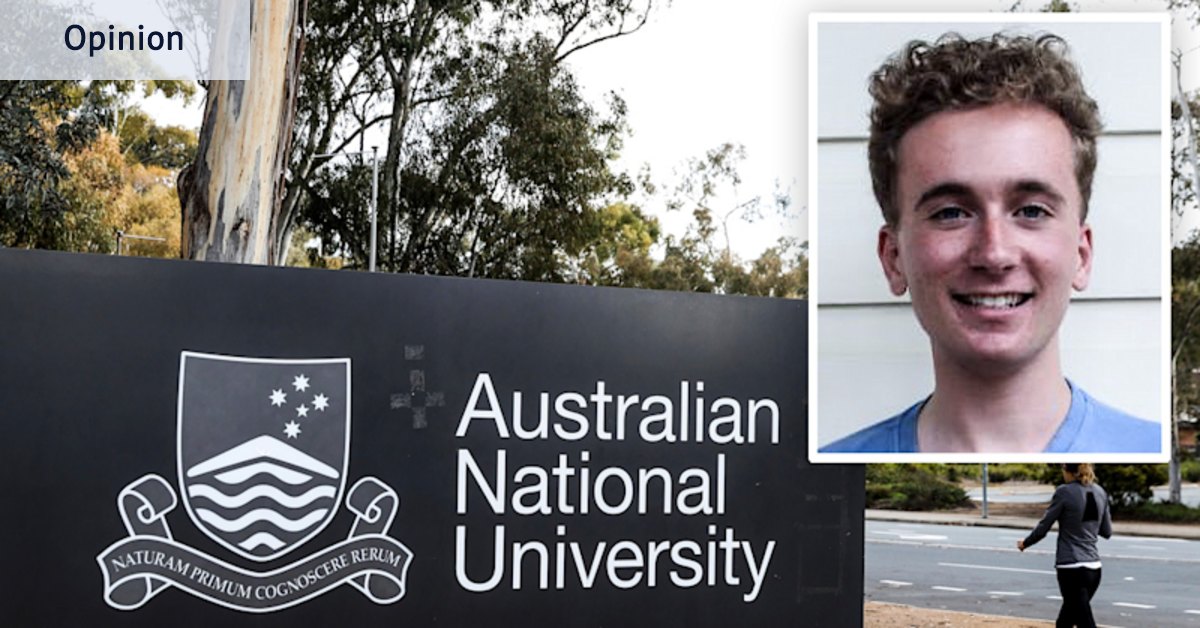
I’m the beneficiary of one of the most generous university scholarships in the country. I want to say the quiet bit out loud: the odds were stacked in my favour to receive it.
Yes, I worked and studied hard growing up. I volunteered inside and outside of school and worked at the weekends. I grew up in the affluent Northern Beaches of Sydney, with writers, artists and lawyers as neighbours. I knew one day I could become like them.
I was in years 10 and 11 during the COVID-19 lockdown. I dreamt of my post-school life, in which I could hopefully move to another city to study, meet friends and start my adult life.
That’s when I came across the Tuckwell Scholarship – it seemed too good to be true. I was nervous because I wanted it so badly. It provided financial support for up to five years, along with social and academic networks, and would pave the way for that dream to become reality.
I went through the scholarship process, asking for references and grades from my teachers, most of whom hadn’t heard of it.
In September 2022, towards the end of year 12, I received a call from doctors Graham and Louise Tuckwell, who told me I had been selected to receive the scholarship. I couldn’t believe my luck.
A few years into living that dream, I know that luck might not be the right word. I’ve seen over the years how my selection follows the trend of the Tuckwell Scholarship favouring applicants from middle and upper-class backgrounds. That word I’m looking for is privilege.
The Tuckwell scholars I know as friends and peers today exemplify dedication and ambition. Most of them are also clearly plucked from the smallest and most elite demographics of Australia.
Private schools in Melbourne and Sydney are notorious for sitting their year-12 cohorts down and advising students to apply for the scholarship. Meanwhile, those in outer-suburban and regional public schools are hardly aware.
Every September, I nervously await the announcement of the new group of Tuckwell scholars. The list states their names, home towns and schools. I run my finger down the screen, adding up the proportion of publicly and privately educated students in my head. Each year, I hope that the students selected will represent the broader Australian community.
In 2026, 40 per cent of the incoming Tuckwell scholars went to public schools, compared with 63.4 per cent of the general population. A total of 60 per cent of incoming Tuckwell scholars come from private schools, many from the most elite institutions where annual fees compete with the average yearly income.
In my first two weeks of coming to ANU, I learnt more about the reputations and connections between the elite private schools of Sydney and Melbourne than I had ever been aware of during my previous 18 years.
What’s more, most Tuckwell scholars come from the highest socio-economic quartile, according to a study of students from 2014 to 2019. Even those of us who are publicly educated typically come from higher-income backgrounds.
The Tuckwell Scholarship has become emblematic of structural inequalities in Australia. While it is promised that students are selected based on “how well you do with what you have”, you are more likely to receive one of Australia’s best university scholarships if you are born into an upper-middle-class family, go to a fancy private school and have the confidence and self-belief to think you have a chance.
Students from high socio-economic backgrounds are impressive because they are given the resources and stability from which children naturally flourish. Students without privilege are the “naughty” kids. Kids who grew up with financial stress hanging over their family, kids whose parents moved to Australia from another country and face perpetual racism, and kids who grew up expecting violence at home.
When I saw the gaping lack of public school graduates in the incoming Tuckwell scholar cohort, I thought about my teachers in year 12. Facing increasingly unfair pay and conditions in the public system, they often went on strike for one day of the week and would open the school on Saturday to make up for the missed lessons so that we would be on track for our HSC.
Stacking on the unfair conditions of far fewer resources, being taught by teachers who understandably burn out and fewer available subjects mean that public school and low-income students have to punch above their weight to get close to the realm of achievements of their private school peers.
Rewarding those who “do well with what they have” is a farce. It abdicates responsibility as a life-changing scholarship to genuinely engage with the deep and structural inequities in this country.
We may be the land of a “fair go”, but it also takes four generations for someone in poverty to reach average income. In Denmark, it’s two, and in Sweden, three.
The generosity of the Tuckwells is enormous. They have created a scholarship that will run in perpetuity. In an unequal society such as ours, it has the potential and responsibility to reward those young adults who have faced a tough start to life.
Only 17 per cent of university students come from a family with low socio-economic status. The Tuckwell Scholarship could prove that doesn’t have to be the case.
Imagine a scholarship that prides itself not on excellence or exclusivity, but on equity. Imagine O-Week conversations being more than hearing about the poshest suburbs in Sydney or Melbourne.
I am beyond privileged to receive this scholarship. It has changed my life. But it’s unfair it hasn’t changed the lives of those who genuinely deserve a place where I am because they happened to have been born into tougher circumstances.
Quotas, outreach to low socio-economic areas and cultural reckoning are needed before the Tuckwell Scholarship truly represents the broader Australian community. Without change, the scholarship risks further contributing to the inequities in our society.
Will Cassell is a ANU student.
 Will Cassell is an ANU student and an adviser to a Greens party MLA