
You have reached your maximum number of saved items.
Remove items from your saved list to add more.
Save this article for later
Add articles to your saved list and come back to them anytime.
Coming of age in the late 1990s, Jessica Seitz, 33, knows the pressures of diet and “skinny” culture well.
“I grew up my whole life with weight issues. You won’t find very many Millennials that didn’t at least have bad body image,” she says.
When she became a mother at 24, these concerns didn’t go away. They morphed to reflect her changing body.
The same culture Seitz grew up with, in which Victoria Beckham was forced to weigh herself on live television two months after giving birth, had evolved into dramatic postpartum weight loss videos, highly edited bikini photos and “bounce back culture” on social media.
“At the moment, thinness, Ozempic, all of those things have become trendy. It’s very reminiscent of the Y2K, ’90s Kate Moss attitude,” says Seitz.
“But back then, you could walk away from a magazine that made you feel bad about your body. Social media is in your face all the time, every day,” she says, adding it is particularly harmful when users don’t disclose how they achieved a certain look.
A recent scoping review from Flinders University found that three in four new mums struggle with body image.
The research backs up what decades of literature shows, including that pregnancy and menopause are close behind puberty as high-risk periods for eating disorders and body image issues in women.
The postpartum period is generally considered to span the three months following birth, but recovery from the intense physiological and psychological changes brought on by pregnancy can take years. Despite this, many mothers are expected to “bounce back” mere months after birth.
“I don’t think there’s enough support for women to understand just how big the changes are in your body in pregnancy to postpartum,” says Seitz.
“To say, ‘hey, your uterus takes up to 12 weeks to even go back to its normal size’. Especially celebrities and on social media, you see all these people that bounce back and that becomes the expectation of all women.”
And in 2026, the “ultra thin” culture of Seitz’s youth seems to be back, spurred in part by the growing prevalence of weight loss drugs (GLP-1 receptor agonists) like Ozempic.
GLP-1s have been shown to be effective in the treatment of type 2 diabetes and obesity. But they are being increasingly prescribed inappropriately, including for small amounts of weight loss.
While there is no official data on whether more new mums are asking for, or being prescribed, weight loss drugs, social media is rife with post-pregnancy “transformations” enabled by such medications. Meghan Trainor and Serena Williams are two celebrities who have spoken about using these drugs to shed weight after pregnancy.
Royal Australian College of General Practitioners psychological medicine chair Dr Karen Spielman says while the college has not observed a marked increase in postpartum requests for weight loss drugs, members have noticed an increase in young mothers expressing body dissatisfaction.
The Therapeutic Goods Administration warns against using GLP-1s during pregnancy and while breastfeeding.
Partners play a role in body image
In the Flinders review, researchers looked at 36 studies published between 1986 and 2024 (more than half were published between 2019 and 2024), from countries around the world, including Australia.
Lead author and PhD candidate Madeleine Rhodes set out to examine the impact of interpersonal and environmental factors on body image, instead of individual factors like self-compassion and depression that most previous research has focused on.
“Of course, those individual factors are incredibly important, but what we’re asking of women and people who are pregnant and in postpartum, to cope despite all of these sociocultural factors and our anxiety around body image … the onus still lies with women,” she says.
“They’re tasked with swimming upstream against this tidal wave of pressure, and I just feel like that is unfair. The responsibility needs to be redistributed.”
The review found supportive partners and strong social networks helped with positive body image, while unrealistic media portrayals, appearance-focused comments and even well-meaning advice (like unsolicited compliments about one’s “small” pregnant body) could do harm.
Dr Briony Hill, a senior research fellow at Monash University with a focus on ending weight stigma in the preconception, pregnancy and postpartum life stages, was not surprised by the results of the Flinders study.
Weight stigma, which she defines as “the social devaluation of somebody’s body because it’s different, and usually because it’s larger or of a higher weight”, is common for women in the perinatal period, including in healthcare settings.
This stigma can have significant health effects, says Hill.
“It can lead to a stress response in the body, which then can increase risks of other health complications. It is associated with increased depression and anxiety, as well as decreasing people’s ability to engage in the usual health behaviours, like having a healthy diet and just being physically active in general,” Hill says.
When it comes to eating disorders, Spielman says there is a range of vulnerabilities that collide in postpartum – from intense hormonal changes, to anxiety and isolation – putting mothers at greater risk.
Context matters too, of course. “10 years ago, people were a little more body positive, and now all of sudden, people are talking about weight loss being an easy thing because you can just get these medications,” says Spielman.
“That’s going to have a downstream impact”.
Social media and the return of ‘ultra-thin’ bodies
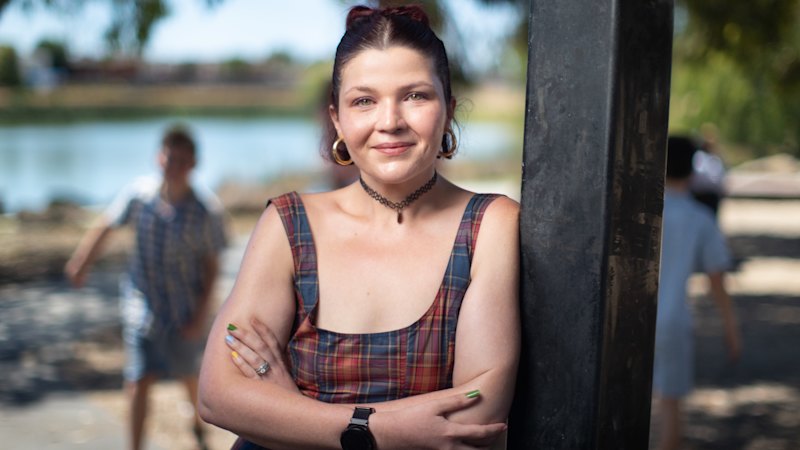
Courtney Stubbs, 28, developed perinatal depression around the births of her two children, and struggled with an adjustment disorder due to the changes to her body.
Indeed, research shows body dissatisfaction is associated with depression.
“The experience of being pregnant the first time was wild mentally for me,” she says.
“I’ve always had control of how my body looked, and to then be growing bigger and bigger was really hard. There were all these beautiful pregnant women, with the perfect bump and still skinny arms or legs, but I felt like I was just heavy, and the opposite of the identity I’d always seen in the mirror growing up.”
Stubbs had been an active kid, and she was heavily involved in dancing, cheerleading and modelling, all activities that put intense pressure on appearance, from a young age.
“I was easily influenced by diet culture and always encouraged, if not pushed, to lose more weight, to book a modelling job, to be on top of the pyramid in cheerleading,” she says.
Stubbs, a business owner and former reality TV contestant with a significant social media following, says this public visibility compounded the pressure to look a certain way after giving birth, and she felt compelled to exercise and eat well, not just for health, but to “bounce back”.
For Seitz, venturing offline highlights the unrealistic ideals for mothers that social media perpetuates.
“If you take your eyes off the screen and go out to your local swimming pool, it’s very eye-opening to see all different types of bodies. It’s really that irregularity of seeing perfectly fit bodies on your screen,” she says.
A 2022 analysis of Instagram found women in smaller bodies were more likely to share images of themselves postpartum than those in larger bodies.
Improving body image
So, what can new mums, and the people around them, do besides simply logging off?
Spielman encourages mothers to lean on their GPs for support and to focus on establishing a solid social network, such as “a good mothers’ group with people who can normalise and share and debrief, so that you don’t feel isolated and like you’ve got to be looking for unhelpful information,” she says.
Given a key risk factor for poor body image is appearance-related commentary, Rhodes encourages people to be more mindful of the language they use around pregnant people.
“It’s almost like a woman’s body during pregnancy becomes this object of public scrutiny,” she says.
“Often this is not necessary, and it’s not helpful, because you don’t know what people have been through. You don’t know if someone has been struggling with an eating disorder [for example].”
Her team’s findings also shed light on the important role partners play in shaping positive body image.
“What I’d like to see in the future is more conversations around body image, which is typically left to women and their friends, with men and partners, which can just break down that stigma,” she says.
“It’s a bit of a check-in because often body image concerns can be an indication of other things like depression or secretive disordered eating … and being quite reassuring and loving is really respectful and can be a powerful thing.”
For Seitz, who started sharing videos of herself on social media after the birth of her second child to normalise bodies like hers, becoming a mother has been an overwhelmingly positive experience, despite some negative comments.
“I have such a lovely community,” she says, “and it’s really helped me feel more confident in my body.”
If you or anyone you know needs support, call the Butterfly National Helpline1800 33 4673, Lifeline 131 114, Beyond Blue 1300 224 636, or PANDA between 9am and 7.30pm on 1300 726 306.
Make the most of your health, relationships, fitness and nutrition with our Live Well newsletter. Get it in your inbox every Monday.
You have reached your maximum number of saved items.
Remove items from your saved list to add more.