

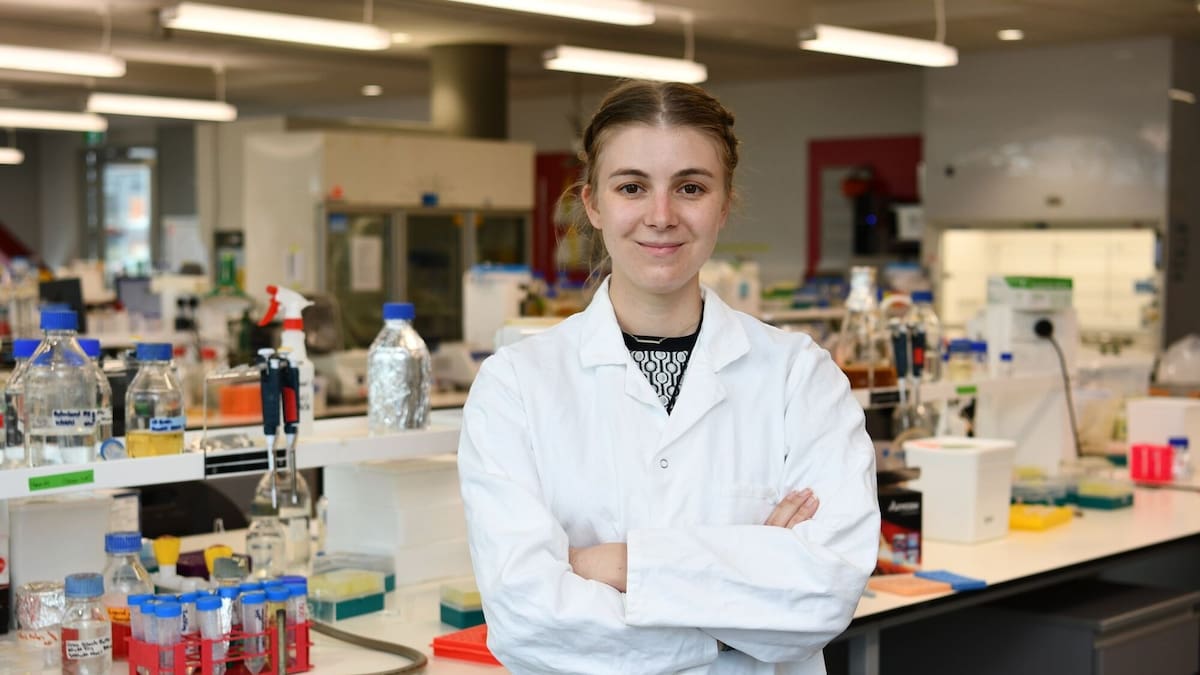
Some are researchers, some are unnamed early makers of lab-grown meat who place Opo Bio’s cells into bioreactor tanks in which they’re fed amino acids, sugars, vitamins.
The cells multiply and differentiate into muscle, fat, and connective tissues, often guided by scaffolding, to form real meat; there’s no genetic modification.
What’s coming in 2026?
Opo Bio plans a Series A capital raise, with the amount yet to be set.
Seed round backers include Tauranga’s WNT Ventures, Icehouse Ventures, Matū, Booster and Auckland University via its commercialisation arm, Uniservices.
Ogilvie says Opo Bio is still calculating how many millions it will need to raise for its next growth spurt.
But there’s already one certainty: it will include a push into collagen, first flagged by the recent addition of a new director, Kevin Darling, an Australian who’s an expert in the field.
Collagen is like the “glue” that holds you together. It’s the primary building block of your body’s skin, muscles, bones, tendons and ligaments.
It’s used in the cosmetics industry to plump up skin or as a face-filler; and in healthcare for everything from a “scaffold” for tissue regeneration in a wound to heart valve repair. It’s also sold as a nutritional supplement, with some hipsters now adding collagen to their coffee.
There’s a clutch of companies synthesising collagen from yeast – a relatively cheap, easy-to-scale process. Chemicals can also be used to extract collagen from bones or hides, a process that Ogilvie says can carry a risk of toxins.
Opo Bio is one of a handful moving into the cultivation of collagen from animal cells, a much more difficult process but one that yields a medical-grade product close to human collagen.

Opo Bio recently posted it was “excited to be an industry partner on a University of Canterbury-led project investigating a solution to two major hurdles faced in cultivated meat product development: scalability [moving to mass production] and flavour”.
A three-year project to tackle those issues has received funding from the Ministry of Business, Innovation and Employment (MBIE) Catalyst Strategic Fund, as part of the joint New Zealand Singapore Biotech In Future Foods Research Programme.
It will see $24 million split over seven initiatives for its second phase (the first helped Opo Bio get off the ground in 2022 as it was spun out of research by Ogilvie and co-founders Dr Laura Domigan and Dr Vaughan Feisst at Auckland and Canterbury universities).
Opo Bio posted, it was “great to see the New Zealand Government investing in future food biomanufacturing, especially following the announcement of the NZ Institute for Advanced Technology, which includes a focus on synthetic biology”.
“These moves signal growing momentum in Aotearoa, and highlight the need for a co-ordinated national strategy to realise the full potential of biomanufacturing.”
Domigan, Opo Bio’s chief science officer, was part of a Government-funded delegation to Europe in September.
“We’re definitely excited that the Government’s moved to create more of a national strategy around synthetic biology,” Ogilvie says.
So far, only a handful of lab-grown meat products in a handful of countries have been approved for sale. One is chicken cultivated by Go Eat, in Singapore.
“It looks like chicken, it smells like chicken and, what do you know, it tastes like chicken,” said a BBC report.

In June, Food Standards Australia New Zealand (FSANZ) made its first approval for a lab-grown meat: Qual made by Australia’s Vow Group, with a “cell-cultured” or “cell-cultivated” labelling requirement.
Last month, Vow started selling jars of its quail spread in Sydney. Its product has also appeared in a handful of restaurants across the Tasman, including Nel, where chef Nelly Robinson served Vow’s quail parfait with red apple compote and a glossed apple gel.
The Wentworth Courier said it was “unlike anything I’ve ever seen before, at once familiar and unique, surprising for its unusual origins and delightful for its rich, umami and complex flavour”.
Complicated presentation is the norm. The Herald could not track down any plain protein taste-tested against an unadorned cultivated meat, where some aspects can be finely tuned, even if it (close your eyes, vegetarians) might lack the flavour that well-exercised tendons and bones can imbue.
Those are all issues for bio-manufacturers to grapple with. Opo Bio is at the start of the process, supplying the likes of Angus and Wagyu satellite cells and Angus fibroblasts (connective tissue cells that produce collagen).
Its founders are still well aware they could be in the firing line, however, and have marshalled their arguments.

“We’re an ‘and’, not an ‘or’,” Ogilvie says. “We work with partner farms across the country.”
Providing cells is a new revenue line for farmers, she says.
And her company is always on the hunt for the best cell lines, “or seeds” as her company calls them. Just as in another field, AI (as in artificial insemination) specialists are willing to pay top dollar for the best bull output of a different type of seed.
Long term, she sees cultivated meat competing with that from livestock in corporate feedlots in various offshore markets.
“Our aim is to grow New Zealand exports,” Ogilvie says.
Domigan adds: “We need to diversify. New Zealand can’t produce more meat than it already does.
“We can try and command a higher price, but we really need to bring in new technologies as well.”

2. Extraordinary
Extraordinary’s app can put hundreds of dollars back into an employee’s pocket, if they use public transport to get to work.
During a July splash to promote the new service – with cameos from everyone from Auckland Mayor Wayne Brown to former Prime Minister Sir John Key – founder Steven Zinsli said several unnamed big firms were on the brink of signing up, and would be onboarded by year’s end.
In December, he was able to reveal that his stable of customers had grown to include Spark, Chorus, ASB, 2degrees, Air New Zealand, PwC, KPMG, Deloitte, Steel & Tube and SBS Bank. Southern Cross was the latest addition, with its staff due to be issued cards in early 2026.
Two big, related items are on Zinsli’s to-do list for the New Year: A Series A capital raise, then a push across the Tasman.
A target has yet to be set for the venture capital round. Extraordinary raised $3.4m in a mid-2024 seed round, taking its total funding to $6m. Its backers include Icehouse Ventures, Anna Mowbray and the Huljich family.
Zinsli uses the example of a white-collar foot soldier earning $70,000 per year. If they make a “salary sacrifice” that involves part of their remuneration going straight to an Extraordinary card to pay for their public transport commute to and from work, then their taxable income will be lowered and they’ll come out $900 ahead per year.
The founder says the arrangement was enabled by a Fringe Benefit Tax exemption passed in 2023, which removed tax penalties for an employer subsidising public transport.
The change had been championed by the Greens and was promising on paper but in reality “was near-on impossible to take advantage of”, the founder says.
He bills Extraordinary as making it easy to unlock – or at least it finally became so after months of meetings between Zinsli and IRD to hammer out the details.

Zinsli says after a firm signs up, it typically surveys its staff to see how many take public transport.
Then, for employees who want to take advantage of the perk, part of their pre-tax salary is transferred into an Extraordinary account – and they can either use an Extraordinary-branded physical debit card (created with Mastercard) or Hop or Snapper or other public transport card fed by their Extraordinary account for public transport.
Mastercard sends real-time transaction data to Extraordinary, ensuring funds can only be spent on public transport.
Extraordinary’s app can also be used for corporate gifting or well-being payments or one-off bonuses.
Taxi and Tax Traders co-founder Nicola Taylor recently took to LinkedIn to reveal staff had been offered a “surprise gift” or a $400 top-up on their Extraordinary card for Christmas.
“The overwhelming majority chose the Extraordinary top-up,” she said.
Zinsli says Extraordinary saw transactions rise from $2.5m to $10m this year, with most of the boost happening in the second half.
His firm now has 40,000 active cards in the market, which will rise to 60,000 in the first quarter of 2026, he says.

Vessev
Electric hydrofoiling boat maker Vessev has had a strong 2025, selling a prototype of its 9m VS-9 to Fullers (for around $1m), then its first two production models to Finn Lough, a luxury eco-resort in Northern Ireland, and a Lake Taupo tourism operator.
Chief executive Eric Laakmann says 2026 will see the firm complete “a machine for making the machines, a production line that can crack out a boat every five weeks”.
Laakmann, an American, spent five years as a lead Apple Watch engineering programme manager before setting off on a sailing sabbatical around the world.
After Covid lockdowns trapped him in Auckland, he took the CEO role with the fledgling Vessev, with founder Max Olson, shifting to CTO.
Olson, the co-founder of Halter, was dreaming big, with a vision for an electric ferry that could cross Cook Strait.
The firm, of course, had to start smaller but there are now 46 staff at Vessev’s East Tamaki plant (a near-neighbour to EV Maritime and McMullen & Wing).
“It’s unusual to have everything made under one roof,” Laakmann says.
Vessev is now also in serious talks for the first orders of its VS-12 (11.5m in length, with a 5m beam) and its VS-18 (19.5m x 10.5m), which will be large enough to serve as a commuter ferry, Laakman says.
With backing in the bank from investors including Australasia’s largest venture capital firm, Blackbird, Icehouse Ventures, GD1, Port of Auckland, NZVC (run by Mark Pavlyukovskyy (a Ukrainian expat who wound up in Queenstown), Rob Coneybeer’s Shasta Ventures and Sir Stephen Tindall’s K1W1.
It wasn’t always such smooth sailing.
The start-up had a “near-death experience” as its money ran dry in mid-2024, one of its key backers told the Deloitte Fast 50 2025 audience.
“They didn’t have months. They had weeks or maybe days,” Icehouse Ventures chief executive Robbie Paul said.
Fresh venture capital was in the offing, but only if the Auckland start-up could get a prototype boat on the water.
“We pulled seven-day weeks for three months straight to get that boat on the water,” Laakmann told the Herald during December.
“Every start-up has that sort of near-death experience. But I think it’s cool having that as part of our experience.
“Those are some of my fondest memories of working; literally being in the bow of the boat, wiring stuff with our head of electrical at 11pm on a Saturday night.
“I’m proud we pulled it off.”
The funding came through and, with its prototype good enough for sale, Vessev became one of the first companies in the world to have an electric hydrofoiling boat certified for commercial use.
“[In 2026] we’ll be going from a company with a worldwide digital presence – in the sense that people are aware of us all around the world – to a New Zealand company that has a worldwide physical presence as we make our first international deliveries. That’s huge.”
Chris Keall is an Auckland-based member of the Herald’s business team. He joined the Herald in 2018 and is the technology editor and a senior business writer.