
As demand soars up to 300 per cent for food support this Christmas, one organisation is taking a different approach.
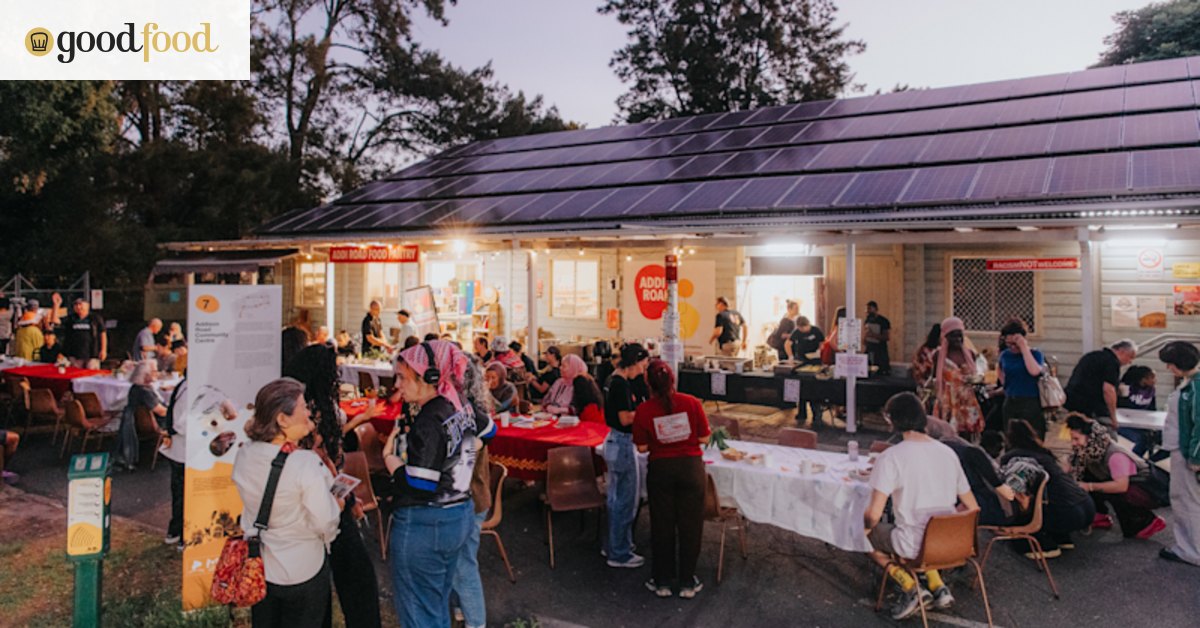
On a recent Wednesday night, more than a hundred people gathered at a long table dinner outside Addison Road Community Organisation in Marrickville. There were asylum seekers, elderly neighbours and young artists laughing over live music; volunteers standing beneath fairy lights, serving food made by former RecipeTin Eats chef Heather Hancock; and tables set with mismatched tablecloths and hand-picked flowers.
They gathered for Wednesday Night Lights, a weekly event that extends an open invitation to anyone seeking a warm meal and sense of belonging. When the independent inner west charity, commonly known as “Addi Road”, launched the initiative two years ago, just five people showed up. Now, the dinner attracts a crowd of up to 200 people, said chief executive Rosanna Barbero.
Like Addi Road’s low-cost food pantries, which serve 8500 customers across Marrickville and Camperdown each week, Wednesday Night Lights provides food assistance with dignity – there is no means testing, no registration, and no judgment.
“We’re not here to remind people that they’re doing it tough,” Barbero said. “This is not like going to a soup kitchen – we invite the whole community here to forge connections.”
Addison Road Community Organisation was awarded The Sydney Morning Herald Good Food Guide 2026Food for Good award for its commitment to empowering community through food, and saving 640 tonnes of quality grocery items that would have otherwise gone to waste. Next year, it celebrates 50 years in operation.
For Barbero, who grew up in an Italian immigrant household in south Sydney, food has long been the language of connection.
“Food is everything,” she said. “Food is connection, communication. Food tells someone you love them.”
Her approach has never been more important. Barbero said demand grew 300 per cent over the past year, mirroring a report from national charity OzHarvest that found 77 per cent of frontline charities nationwide had witnessed a surge in people seeking food.
That need increases over the Christmas period, said Foodbank chief executive John Robertson. Foodbank plans to collect about 400 tonnes of rescued food per week, 100 tonnes over the usual amount.
At Addi Road, more than 400 volunteers, including Kylie Kwong and Jimmy Barnes, worked to create 2000 gift hampers. And at OzHarvest, the free supermarkets are expected to welcome upwards of 600 people a day.
“For us, it’s such an important time because while all of us are celebrating – and this is the festive season – there is a huge demographic of Australians who will be struggling,” Robertson said.
This year, an estimated 3.5 million households across Australia (1.1 million in NSW) struggled to put food on the table, according to the Foodbank Hunger Report published in November. More than two-thirds reported experiencing food insecurity for the first time.
“One in three households have been forced to skip meals at some point over the past 12 months because they just don’t have enough money … and unsurprisingly, cost of living is the No.1 concern for those families, followed by housing,” Robertson said.
“It’s hard to believe in the so-called lucky country, but sadly it’s a growing problem.”
Housing and food are the largest contributors to annual household inflation, according to ABS data, and it’s affecting broad swaths of the population.
“In recent months we’ve noticed a clear shift,” Barbero said. “People from all walks of life, not just those traditionally seen as disadvantaged, are seeking help.”
Among those who gather at Addi Road are an award-winning journalist, a young man with a doctorate in physics, and a woman who has resorted to living in her luxury four-wheel drive.
“A single life event can tip the balance between stability and crisis,” Barbero said. “I remember when my parents had shocks, there was a safety net, a cushion. What I know now is that there are no safety nets.”
OzHarvest chief executive Ronni Kahn calls them “the working poor”: “According to the Anglicare [Social Impact] report, if you’re a dual income family who are working on an award wage, you might have $40 left at the end of the month,” she said.
“We have a hidden crisis.”
Each week, more people join Plates4Mates’ Sunday meal service at Royal Prince Alfred Park, for home-cooked meals made by a 15-strong group of regular volunteers, including Stella and Greg Littlefair.
Like Addi Road, Plates4Mates relies on individuals to donate their time and resources. Sometimes, the grocery bill is paid out of their own pocket. Other times, they source leftover ingredients from supermarkets and bakeries.
“We were doing about 120 meals at the beginning of the year … since [COVID], it’s just skyrocketed, especially over the past nine months,” says Greg Littlefair. “We’ve had two services this year when we ran out of food.”
It’s a lot of pressure, says Stella Littlefair: “If we don’t do it, then you’re going to have all these people wind up in the park, and they might not get a meal.”
Charitable food providers have been pushed to their limits. This year, OzHarvest reported a 54 per cent increase in people being turned away from frontline charities nationwide, with an estimated 50,000 people unable to access support.
“We deliver food to around 1800, sometimes 2000, charities, [but] we have 1330 charities on our waitlist,” Kahn said. “We don’t have the resources to feed everybody.”
Barbera said Addi Road is getting to the point where she’s concerned they will have to turn people away: “I am so worried … we just can’t, we never have, but we’re getting close to that.”
Kahn said she is determined to fight food insecurity in Australia, having founded collaborative research and funding project Hunger Solutions Lab. Her charity, among dozens of others, contributed responses to the federal government’s development of Feeding Australia, a national food security strategy set to be implemented by 2027.
“When I started OzHarvest 20 years ago … we understood there were around 3 million people who needed food at any given time,” she said. “Now, there are 10 million Australians who need food. I don’t want to be here in 10 years’ time, telling you there are 20 million.”
Restaurant reviews, news and the hottest openings served to your inbox.
 Bianca Hrovat – Bianca is Good Food’s Sydney eating out and restaurant editor.