

You have reached your maximum number of saved items.
Remove items from your saved list to add more.
Save this article for later
Add articles to your saved list and come back to them anytime.
Few plants are as polarising as bamboo. This plant does nothing by halves. There’s the break-neck speed of its growth, the loftiness of its form and its definitive way of screening out neighbours. For every person who loves this giant grass, there’s another who hates it.
But with more than 1500 different bamboo species, it’s hard to be definitive. Some bamboos are so slender they can squeeze into narrow boundary beds, others are so tough they can form a windbreak.
Some bamboos strike such graceful weeping poses they soften the mood of your entire garden. Others, however, are full-blown thugs. Everyone has heard stories of bamboos punching through fences, pushing through paving and casually breaking every containment line.
Telling the difference
Bamboos can be divided into those that run and those that clump, and it’s the runners that are the most invasive. Their long horizontal roots, or rhizomes, send up such a profusion of new shoots that, without specialised root barriers, they are near impossible to contain.
Clumping bamboos, on the other hand, have more compact root systems and these bamboos expand – more slowly and predictably – outwards. These are the ones commonly recommended for urban screening.
But in the late 1970s when composer and avid gardener John Tallis, decided to add bamboo to his coastal Victorian garden, he did what many Australian gardeners did at the time and opted for a runner. He bought four or five pots of golden bamboo (also known as fairyland bamboo, Phllostachys aurea,), now an environmental weed in NSW, ACT and Queensland.
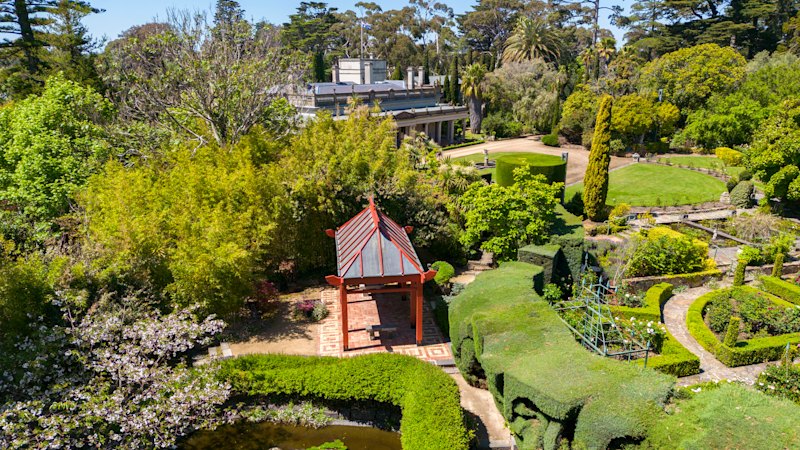
No surprises what happened next. The Phllostachys aurea spread and spread. It currently forms two 1000-square-metre stands in the grounds of what is now the heritage house museum Beleura in Mornington, and would be running further if not for the fact that shoots growing outside these areas are cut and poisoned.
Beleura’s head gardener, Richard Smith, says much of this bamboo forms the basis of an Asian garden that has become “integral to the place”. Smith says it is a maze-like space with a golden tone that “really works.
“You can walk through it and get lost it. It feels mysterious,” he says.
An unexpected bamboo sighting
But, about 18 months ago, it started to create mystery of a different kind. It lost its glow and turned pale and lacklustre. Nothing – not extra food or water or rat traps (lest rodents were eating the roots) – returned the bamboo to health. And then last October, Smith saw something he had never seen on the bamboo in his 20 years at Beleura: flowers.
They were small and inconspicuous, but they were on every bamboo plant across the garden. Smith concluded that, with so much energy going into the flower production, the plants were being sapped of life. But that wasn’t his only concern. “I was terrified about all the seeds. If, after such a mass flowering, seeds were spread everywhere it could almost be the end of the garden.”
Immediately he started cutting the bamboo down to the ground and by mid-December there was none still standing. Within weeks, it was growing back lush and green but then – alarmingly – a new round of flowers appeared.
“I am terrified again,” Smith says. “I am now cutting down all the flowering stems.” He has also arranged to entirely remove one of the stands. But, with dense roots extending almost one metre deep into the earth it will not be easy. Smith is currently organising excavating machinery. He says he doesn’t know what to expect next.
What to do if your bamboo starts to flower
The flowering of bamboo is famously unpredictable. Durnford Dart, founder of Bamboo Australia, on the Sunshine Coast, says you can spend a lifetime studying flowering habits of bamboo and not know it all.
Some bamboo species take decades to flower. Phllostachys aurea can be subject to both sporadic and gregarious flowering at intervals of between 15 and 30 years. While sporadic flowering occurs on only some stems of the same clump of bamboo, gregarious flowering means that all the plants in the one bamboo variety bloom at the same time, regardless of their location and climate.
After gregarious flowering the bamboo often dies and, unless the setting of fertile seed leads to regeneration, every plant of a particular variety – across both hemispheres – can be lost.
Smith wonders whether Beleura’s golden bamboo is undergoing such flowering. Dart says he has heard of two varieties of black bamboo (Phllostachys nigra) currently being in the midst of a gregarious flowering event but at this stage is not aware of the phenomenon striking any varieties of Phllostachys aurea. But he says it is possible. Otherwise, the Beleura stands might be sporadically flowering.
Either way, Smith says it is extraordinary to watch the process unfold. He says he loves the idea of the one plant flowering everywhere all around the world, but it scares him too. “I’m taking it one step at a time.”
Make the most of your health, relationships, fitness and nutrition with our Live Well newsletter. Get it in your inbox every Monday.
You have reached your maximum number of saved items.
Remove items from your saved list to add more.