
You have reached your maximum number of saved items.
Remove items from your saved list to add more.
Save this article for later
Add articles to your saved list and come back to them anytime.
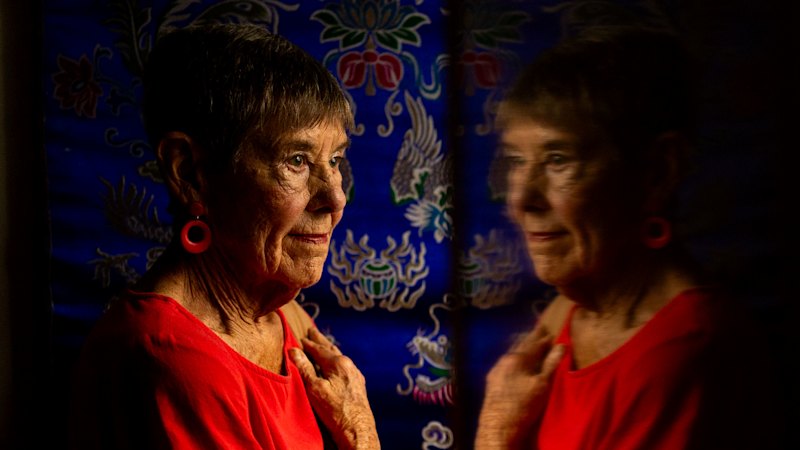
Eighty-six-year-old Jill Nash’s life has been shaped by death. In her 20s, her youngest daughter Bridget died what she calls a “miserable” death at 18-months, after being born without a bile duct and later contracting meningitis.
Then, her husband was diagnosed with bowel cancer in his 40s. He never said a proper goodbye, leaving Nash with a letter and their three young kids, to go and die alone in a hospice in England.
Nash was left to pick up the pieces, cobbling together paperwork and arranging to have his body flown back to Australia for cremation. There was no time to grieve.
“It was a total mess. I was extremely angry,” she says.
Her second husband, whom she was separated from at the time, died suddenly in a plane crash.
“We do death very badly,” she says.
“I resolved that that should never, ever happen again to our family.”
In the years since, Nash has become a passionate advocate for dying well, and on one’s own terms, designing seminars on end-of-life planning, leading local conversation groups on death and serving on working groups for ageing well (including previously on former independent federal MP Kylea Tink’s Ageing Well committee).
Her plans for her own death are extensive, detailed in a thick yellow binder she refers to as her “Golden Oldie Folder” (all backed up on USBs, of course), and include everything from an advance care directive to an emotional will (a non-legal document about one’s personal legacy – memories, life lessons and well wishes for loved ones) and funeral plans.
She would like to die at home, surrounded by friends and family.
Not all of us can hope to be as lucky as Nash, as more Australians face the prospect of dying without a partner, child or loved one by our side.
Unfortunately, data on how many Australians die a lonely death is difficult to find, given it’s not something demographers tend to focus on, or government agencies such as the Australian Bureau of Statistics track.
But researchers and those within the industry say it’s a growing concern because of our ageing population, the increasing number of people living alone and general lack of death literacy. Anecdotal evidence from forensic cleaners suggest it’s becoming more common too.
Camilla Rowland, chief executive of Palliative Care Australia, says lonely deaths are increasing along with “the growing older and more frail population in Australia [and] the shortage of specialist palliative care health professionals”.
In Australia, more than one-third of those over 65 live alone. More people are also dying while facing homelessness, of which women over 55 are most at risk.
And, as the fertility and marriage rate continue to drop, it’s likely the number of solo agers will rise. The ABS estimates that by 2046, between 3.4 million and 4 million Australians will be living alone.
The fear of dying alone
Dying alone is a common, almost primal fear. There’s even a term for it – monatophobia, a portmanteau of thanatophobia (fear of death) and monophobia (fear of aloneness).
TV personality and author Lucinda Light, 45, always thought she would be a mother. But after a long-term relationship ended in her late 30s, she realised it might never happen.
While she lives a fulfilling life, surrounded by loved ones and doing work that matters to her, dying alone is something she worries about.
“When I think of me [dying], I’m like, ‘Shit, I don’t even have a partner. I don’t have children,’ ” she says.
“And that thought is a little bit scary. What will I do? Who will look after me? Will I have loved ones around me?”
Light is lucky that her best friend is Baci Hillyer, a death literacy advocate and founder of Deadicate, who has pushed her to start planning for death, even if it can be confronting.
Dr Rachel Menzies, a clinical psychologist and researcher who specialises in death anxiety, says, “Humans are inherently a very social species across our evolutionary history.
“So it’s completely normal and wired into us that in any time of distress or pain or discomfort, we crave the company of other people. Of course, death is the ultimate situation in which all of those vulnerabilities would be exposed.”
For others, death can intensify general feelings of abandonment.
“Death in and of itself can be seen as this ultimate experience of being alone,” Menzies says.
But Hillyer, who has worked in palliative care, says not everyone fears dying alone – some prefer it.
“There was one lady who needed to look perfect, and she just didn’t want her children to see her like that [dying],” she says.
Kylie Hutchinson is president of No One Dies Alone Australia, a program started in the United States over 20 years ago that pairs volunteers with someone near the end of life.
Dying alone, she points out, can mean two different things: literally being alone in the moment of death, and being alone in a more figurative sense, like having no one attend your funeral, being lonely in the lead-up to death or not being remembered.
The latter is usually what people fear, whereas the former is often just an inevitable part of the dying process.
“There’s this layer of guilt where people go, ‘My mum died when I stepped out to go to the toilet.’ And it’s like, of course they did, because they just couldn’t [die] while you’re holding their hands. They’re too attached to you,” Hutchinson says.
Social isolation
Inherent to these growing concerns about dying alone are the growing rates of social isolation, particularly among elders.
About one in five older Australians have experienced loneliness, which increases to a third for those in residential aged care. Those living on a low income, with a disability, in a rural area, or who are childless and/or single are also at greater risk of loneliness.
This issue is not unique to Australia. In China, where millions live alone, a new app called Are You Dead? has skyrocketed in popularity.
And in Japan, the country with the fastest-growing ageing population in the world, an entire industry is devoted to cleaning up after solitary deaths.
Debra Nicholl, chief executive of Elder Rights Australia, thinks a big part of this disconnect is cultural.
“There’s a devaluing of older people, and then that means they’re not included in things,” she says.
Strengthening community bonds, particularly intergenerational ones, is something Nicholl is working towards with Elder Rights Australia’s volunteer program that connects older people to a friendly face.
“It alleviates that fear of, ‘no one knows, no one cares’.”
The ‘medicalisation’ of death
For Hillyer, another reason so many of us fear death is because in Western societies, we rarely see it.
“We’ve outsourced death,” she says. “We did death so much better over 100 years ago. Death was a part of life, and it was a community event, not a medical event.”
Most deaths in Australia occur in hospitals, while less than 15 per cent of deaths occur in the home, according to the ABS. Despite this, up to 70 per cent of Australians want to die at home, a Grattan Institute survey revealed.
Death doula Danni Petkovic thinks the reasons so few Australians die at home – despite wanting to – is because we fail to talk about death early.
“When death is not discussed, decisions are outsourced to emergency systems,” she says.
“Ambulances are called because families panic. Doctors are forced to act without guidance. Older people end up in intensive care units where life-saving interventions cause pain and indignity rather than comfort. Families later say, ‘They would never have wanted this,’ but by then it is too late.”
Most people think of palliative care as a last resort, says Rowland.
But she emphasises getting to know your palliative care provider early improves health outcomes, reduces costs, “supports continuity of care and allows good planning [such as for a home death] for when symptoms worsen and needs increase”.
For Petkovic, talking about death – and doing so early – is central to being prepared. Even a simple conversation with a loved one about what song you’d like to have played at your funeral or what you’d like to be buried in, is a step in the right direction.
“Talking about death does not make it happen sooner. What it does is reduce fear,” she says.
“People who prepare, document their wishes, and speak openly with family consistently report a sense of relief and freedom. Something loosens. The dread softens. Control is restored.”
She wants to see greater death literacy throughout society – in homes, schools, aged care homes and among healthcare providers.
“We do death badly because we do it silently.”
Curious about death or want to learn more?
- Find a local death cafe: a facilitated, group discussion of death in an informal, non-judgmental space. Many local councils run regular death cafes. International organisation Death Cafe also has a directory of virtual events and upcoming events in Australia.
- No One Dies Alone Australia is an organisation that pairs volunteers with those at the end of life. Palliative Care Australia has its own volunteer program, while many aged care homes and healthcare services also provide end-of-life companions.
- If you receive a diagnosis about your health, get to know your local palliative care provider early, who can provide support and talk to you about your options.
- Other resources and services include: Death Literacy Institute; Deadicate; Proveda.
Make the most of your health, relationships, fitness and nutrition with our Live Well newsletter. Get it in your inbox every Monday.
You have reached your maximum number of saved items.
Remove items from your saved list to add more.