
Vue de Monde “wunderkind” Hugh Allen’s ambitious Fitzroy Gardens project, Yiaga, achieves a significant accolade out of the gate.
You have reached your maximum number of saved items.
Remove items from your saved list to add more.
Save this article for later
Add articles to your saved list and come back to them anytime.
Contemporary$$$$
I am not a furniture critic. In terms of talent when it comes to assessing restaurants, considering design is not my strongest suit. And yet, I fear I could spend the entirety of this review’s word count rhapsodising about the chairs at Yiaga.
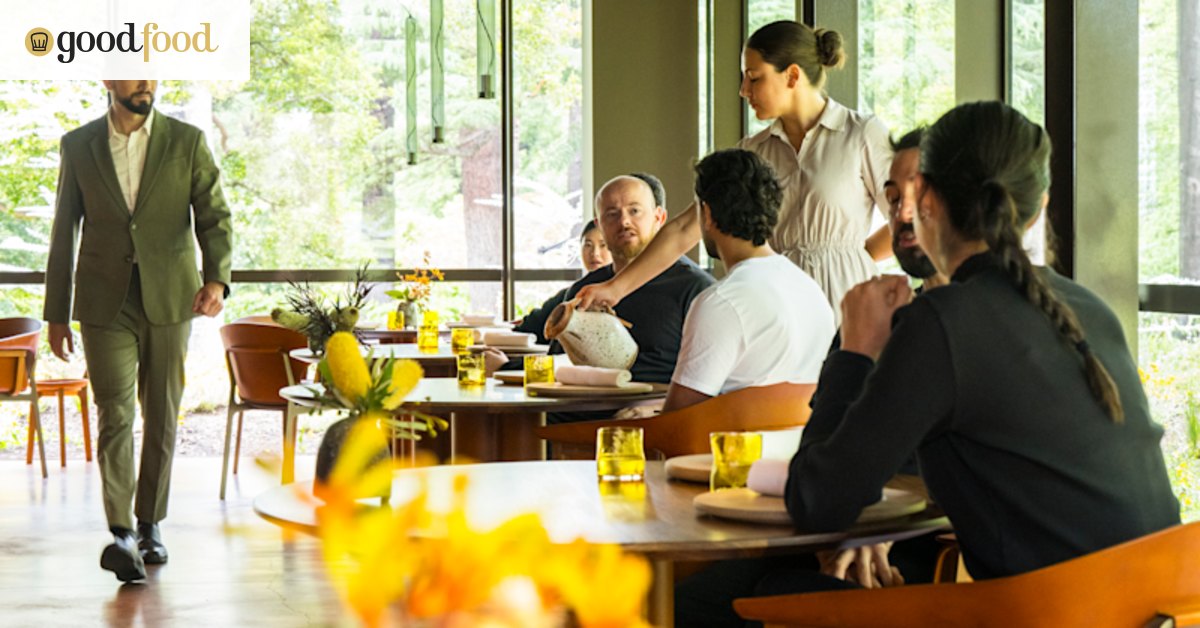
Designed by John Goulder and made of Tasmanian blackwood, brass and moulded leather, Yiaga’s chairs are by far the most beautiful I’ve encountered in a restaurant setting. They are wide but not too big, and the arm rests are curved, embracing your forearms in a way so natural, it feels like a design revolution.
Why do I care so much about the chairs? Because they speak to the obsessive level of care that has gone into every aspect of Yiaga, a project that’s been forming for almost six years and that is one of the most ambitious restaurants Australia has ever seen.
It’s hard not to get bogged down in the details of the place: the terracotta tiles that make up a continuous curved wall, each one hand-made for the exact spot in the undulating room where it exists; the artisan ceramics made specifically for various dishes; the exterior that pays homage to the trees in the surrounding Fitzroy Gardens; the way those gardens are a part of the room, designed by architect John Wardle, the intense green of the trees and the slant of the sunlight surrounding you as you eat.
Restaurant reviews, news and the hottest openings served to your inbox.
At some point during your meal, a staff member will offer a tour of the building, pointing out drawers and ice wells integrated into counters, an open kitchen that manages to be strikingly handsome, but also as functional as any steel-and-plastic counterpart could hope to be. These things are all part of the ethos that makes Yiaga exceptional. Nothing is unconsidered. Beauty is the underlying philosophy. Australia, its landscapes and ingredients and culture, is the muse.
Yiaga is the first restaurant as owner for Hugh Allen, the wunderkind chef who took over the top job at Vue de Monde when he was only 23 (he’s now 30, and still holds the title). Allen shares ownership of Yiaga with the Far East Organisation, the real estate and development company that acquired Vue Group (and hence Vue de Monde) in 2020.
The two restaurants are obviously connected, though Allen owns no part of Vue and Yiaga is a separate business entity. But there is a lot of staff crossover, meaning many of these folks have already worked together for years. That leads to a sense of cohesion that’s rare in a brand-new restaurant.
Located in what were originally Victorian-era tearooms that burnt down in the mid-twentieth century, the restaurant, which opened in October, is one of the purest expressions I’ve seen of a chef’s vision. The kind of project that’s only handed to someone in whom someone else with deep pockets has huge confidence. It’s a dream restaurant, for Allen and for Melbourne.
The 12-course menu lasts three to four hours and begins with a cooling and verdantly green sorbet that straddles the line between sweet and savoury, the flavours of sea parsley, finger lime and olive oil adjusting your mood towards calm and beauty.
Most of this menu is acid-driven, brightness and sunshine and seafoam forming a fantastical and ethereal version of Australiana, one that reminds me of the illustrations of Ida Rentoul Outhwaite, the early twentieth century author and illustrator who saw the Australian landscape as a backdrop for magic.
Squid sliced into tender slivers is bathed in a delicate broth of Thai basil and desert lime; school prawns are served raw and topped with fronds of uniquely floral torch ginger.
‘It’s a dream restaurant, for Allen and for Melbourne.’
The closest to a crossover with Allen’s other gig is the caviar dish, which shares much of its DNA with a caviar/macadamia/seaweed presentation that has become a signature at Vue de Monde, appearing in various guises throughout the year.
Here, he keeps the macadamia in the form of oil, but the base of the dish is coconut cream and coconut water made into a gel of sorts. The result is a beguiling mix of creaminess, soft saline and nutty umami – the caviar gets a bit lost in the other flavours and I suggest eating a spoonful on its own just to savour its subtlety, but the whole is also smashing.
Mains are cooked on open flame in a built-in stove contraption that required Herculean feats of engineering and plumbing to install. In the restaurant’s earlier days, I felt the staff were still learning to master the grill – fish was slightly overcooked, kangaroo chops could have used a touch more heat and sear to avoid chewiness. But these days the skin of coral trout comes blistered and crisp, its interior yielding and moist, served with bawdily ripe mango. And the finale of kangaroo is just rare enough, its rich gravy accompaniment spiked with native peppers. You’ll be served chewy sourdough to mop it up; you’ll need it.
If there’s a signature dish already, it’s probably the banksia pop, a frozen treat made of dark chocolate, chocolate caramel and sesame caramel that references the nostalgia of a Paddle Pop but comes in the shape of a banksia husk, served skewered on a banksia branch – chewy and sweet and salty and fun.
It is almost unheard of for a restaurant to earn three hats out of the gate from this masthead, partly because any venue in its early days has ways to grow and become its best self. I’m not suggesting that Yiaga is perfect in its current iteration, or doesn’t have ways in which it might become better.
Allen is so passionate and has such specific ideas for the restaurant that I fear he fails to cede control to experts in certain aspects. The final petit-four, for instance, is a little clumsy when compared to the best confections, and even that banksia dessert could use a smidge more elegance. Right now, there are no cocktails on the menu, an odd exclusion, though Allen says they’re looking to add some in the future. But I fear he may fall into the same trap there, working on them himself rather than hiring a bartender with his level of dedication to their craft.
The drinks program in general, while exciting, is uneven: more affordable local labels give way to hugely expensive cult and European bottles, without much in between. (During one meal I asked for something the sommelier might consider a bargain and he assumed I meant somewhere in the $300 range.) For a restaurant of this ambition, I’d like to see a broader and more inclusive list. I reckon it will probably get there.
But I’d be lying if I said that, even in its infancy and with its small flaws, Yiaga isn’t already one of the best restaurants in the country. The food is personal, considered, delicious. The service exemplifies what Australia has to offer at its apex: true professionalism underpinned by the humanity and grace of the people who work there. Indeed, this is one of the most pointedly Australian restaurants that exists at this level. You could not experience this meal – not the food, not the design, not the illustrious magpie perched just beyond the glass – anywhere else.
If I had the means, I’d fly in from just about anywhere to eat here. Isn’t that the very definition of world-class?
The low-down
Atmosphere: Serene, contemplative, like eating inside an artwork that considers the Australian landscape and becomes part of it.
Go-to dishes: Squid, Thai basil and desert lime; coconut, macadamia and caviar; coral trout, mango and blood lime.
Drinks: An ambitious wine list that hits all the global highs, plus some local labels; spirits; various pairings available.
Cost: $295 per person before drinks.
Good Food reviews are booked anonymously and paid independently. A restaurant can’t pay for a review or inclusion in the Good Food Guide.
You have reached your maximum number of saved items.
Remove items from your saved list to add more.