
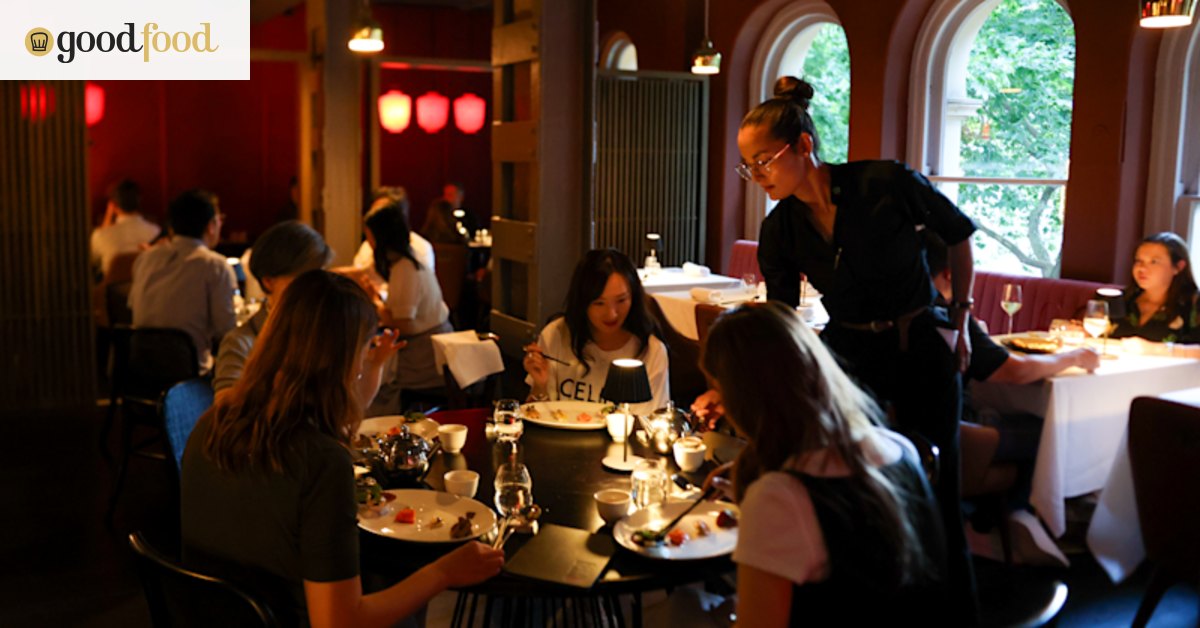
When the young Chinese Australian chef Victor Liong opened more than a decade ago, he brought a refreshing high-wire approach to Chinese food. Can his venue be replicated in Sydney?
Chinese$$$
Sydney is a city deeply connected to its Chinese history. Its restaurants reflect more than two centuries of immigration, its Chinatowns are many and varied. So why haven’t we had more restaurants like Lee Ho Fook?
Resisting the urge to draw up a Sydney-Melbourne, Golden Century-Flower Drum matrix, the simplest way to articulate it is that there’s just nothing like it. When it first opened in Melbourne in 2013, Lee Ho Fook was quietly revolutionary. A young Chinese-Australian chef, Victor Liong, took the food of his heritage, brought in threads from his career in high-wire fine diners in Sydney and created something thoroughly refreshing and new.
It manifested in bites as refined as a hollowed-out baby cucumber filled with the hot, numbing crunch of Sichuan chilli crisp and piped with savoury cashew cream – the after-school snack dreams are made of – right through to jasmine rice-infused ice-cream finished with a cascade of warm cocoa caramel that riffs on a hot-fudge sundae.
Previously, these and other Lee Ho Fook classics were only available with a return trip to Melbourne, but the September launch of a Sydney outpost facilitated by Trippas White Group (it also runs restaurants at Sydney Tower, the Botanic Gardens and Taronga Zoo) has suddenly made Liong’s greatest hits more accessible for his diehards, and opened up his layered, detailed cooking to a whole new audience.
This is big news. Liong has launched two Melbourne restaurants in the past couple of years, including a sushi train soundtracked by bossa nova, and a fast-casual canteen offering curry pot pies and bang-bang chicken bowls. In Singapore he’s collaborated on a South-East Asian fine diner in the Artyzen hotel. But Liong’s only previous foray here was Chuuka in 2019, a Chinese-Japanese fusion restaurant run with former Sokyo chef Chase Kojima. Chuuka had its moments but this city never saw Liong at his best.
Lee Ho Fook Sydney is a chance to correct the record. Jump on the tasting menu and those cucumbers come alongside a couple of other snacks, including one of the most levelled-up prawn toast renditions around: the mousse sweet, the bread fluffy, the richness of a Tasmanian sea urchin topping amplified by a pot of salted egg yolk butter. Hot, cold; cooked, raw; crunchy, soft. Liong weaves them all together, drawing on Chinese tradition but also the here and now.
A course poetically named “Four Dances of the Sea” scales down a couple of a la carte options then adds scallops lightly cured by aged black vinegar, the lush texture playing against the crunch of wok-fried then chilled black fungus.
Peking duck, available on both menus, is glazed with maltose to cartoon-like sheen and crackles to the bite, in pancakes or loaded with Chinese caviar for a totally outre opener in keeping with Liong’s ever-present sense of fun (see also: the duck-shaped wine decanters).
These are all signatures but there’s no dish more hyped than the crispy eggplant, developed while Liong was sous-chef at Mr Wong and inspired by the fish-fragrant eggplant at South Yarra’s legendary Dainty Sichuan. The trick is in the sauce, with sweet-sour punch from red vinegar, doubanjiang and liquid glucose. It coats the crisp, cloud-like batter without making things soggy, even as the kitchen cools it just enough so the eggplant encased in the centre isn’t molten.
Pulling off this dish is one more win for executive chef Brad Guest, signed from two-hatted Shell House to lead the kitchen. Steamed toothfish subtly scented with ginger and served over a base of silken tofu is pushed too far in the steamer but you can tell the interplay of textures is incredible when it’s spot-on.
Less fixable? The entrance is confusing, the holding bar is a dead zone. But then Bar See See upstairs, which is all about baijiu, is one of the city’s most inspired recent openings, and the attention to detail extends to the floor, where Liong’s sister (and former King Clarence manager) Nance Liong reps everything from an ambient tea pairing crafted with Tea Craft’s Arthur Tong, to a wine list that draws on North Central China as readily as it does Canberra District or Chinon. “There’ll always be a Liong at Lee Ho Fook,” she says.
Even when it’s not Victor, this is him as experienced restaurateur. Graceful enough to credit every employee on the menu. Intuitive enough to know that developing a Josper-powered grill section here won’t undercut the aura but add to it, especially when the steak course is a slab of short-rib, rippling with fat, plated alongside short-grain rice, herbs and bibb lettuce for wrapping (plus optional salt-and-pepper fries nodding to late nights in London’s Chinatown). Shout-out to the lamb skewer, too, with just the right amount of searing-hot fat and cumin spice.
It’s a place to pique curiosity, taste familiar dishes anew, to go haute or to simply sink into the comfort of XO-scented Fujian fried rice drowned in swimmer crab gravy, then double down with live seafood. Can it spark more revolution? For now, it’s enough that it’s finally ours.
The low-down
Atmosphere: Polish and comfort with hints of red, in the heritage Porter House building
Go-to dishes: Brilliant tea, from a rose-scented house blend to hearty, uplifting dragon well, margaritas turned spicy with Lao Gan Ma, and a wine list that looks to Australia first (Melbourne’s list is almost all Australian), then folds in elegant global counterparts
Drinks: Crispy eggplant with spiced red vinegar ($29); Lee Ho Fook Peking duck ($64 for a half; $120 for a whole); steamed Glacier 51 toothfish with silken tofu, ginger and spring onion oil ($59); Riverina short-rib with black garlic glaze and ginger, shallot and wasabi condiment ($78)
Cost: About $240 for two, plus drinks; or $360 for two for a tasting menu
Good Food reviews are booked anonymously and paid independently. A restaurant can’t pay for a review or inclusion in the Good Food Guide.
Restaurant reviews, news and the hottest openings served to your inbox.
 David Matthews is a food writer and editor, and co-editor of The Sydney Morning Herald Good Food Guide 2025.