
Last year, Brazilian actor Wagner Moura felt he had good reason to be proud of his country. Former president Jair Bolsonaro, who had tried to foment a coup after he was voted out of the presidency, was properly tried, convicted and put in prison. The democratic institutions were working as they should.
“We had the same thing in Brazil as the US,” he says. “An election denier who made people want to break up their institutions. But Brazil was very quick to do the right thing, I think because we know what a dictatorship is.”
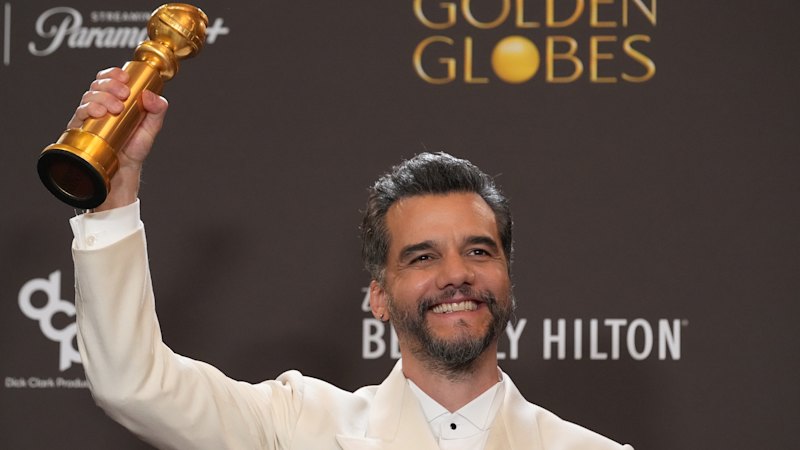
Brazil lived under a dictatorship for 21 years, from 1964 to 1985. The movie revisits the period under the iron control of one of its dictator presidents, General Ernesto Geisel, from 1974 to 1979. It is a period revisited in The Secret Agent, in which Moura plays a university research scientist who falls foul of authorities and must try to escape the country with his son. His performance won him the best actor (drama) award at this week’s Golden Globes. Moura, who achieved star status as Pablo Escobar in the Netflix series Narcos, dedicated his win to “the ones sticking to their values in difficult moments”.
The film itself, written and directed by Kleber Mendonca Filho, has been similarly honoured on the awards circuit. Having picked up the Golden Globe and Critics’ Choice awards for best foreign film, it is now favoured to take out the Oscar in the same category.
Set in 1977, the film follows university research scientist Armando (Moura), who finds himself at odds with the national energy behemoth’s executives who are taking charge of his department’s projects. As he attempts to flee he turns to an underground resistance movement for help.
Armando isn’t a gun-toting rebel. Mendonca Filho says he imagined him as an amiable, Jimmy Stewart-style everyman. “But this is in the manual of fascism,” says Moura, who brings a professorial charm to the role; you can imagine students having crushes on him. “The first ones to go to the fire, the first to go to jail or get prosecuted, are journalists, university professors and artists. Which I think is about truth. We all approach the truth in different ways.”
President Bolsonaro and his supporters, he says, were keen to follow that manual. “Crazily enough, I think Bolsonaro is sort of responsible for The Secret Agent,” says Moura. “Kleber and I were both very vocal against him and both suffered the consequences of that.”
Moura directed a feature film about a ’60s guerrilla, Marighella, which was effectively censored for several years when the relevant government agency refused to allow its release. Mendonca Filho was publicly vilified for his criticisms of the regime. “So I think this film came from our shared perplexity at a government that was bringing back the values of the dictatorship,” says Moura. “It began with Kleber and I calling each other and saying, ‘What the f— is going on? How are we going to react to this?’”
Mendonca Filho’s response was to try to remind his country what that dictatorship was like. A younger generation, he says, is surprised to learn from films like this one – and Walter Salles’ Oscar-winning I’m Still Here, about a real family ripped apart by the dictatorship – that there were disappearances, torture and terror.
“Brazil suffers from a memory problem – and I don’t think that problem is there by chance,” Mendonca Filho says. “When you see the big tech companies allied with governments with authoritarian tendencies, those alliances are not by chance, either.”
They are all there to serve their own interests; inconvenient memories get in the way. According to Moura, that amnesia predates the dictatorship; it is a national habit that has been drawing a veil over unpleasantness for centuries.
“You know Brazil was the last country in the Western world to abolish slavery?” he says. “Colonialism is still very present in Brazil, [imported] from Portugal but also the United States.” Both treated South America as their backyard. “When you see Trump invading Venezuela, it’s just that old mentality at work.”
The Secret Agent’s act of remembering is not, however, much concerned with the particulars of politics; Geisel’s name is never mentioned, even if his portrait is everywhere. Instead, Mendonca Filho focuses on the atmosphere created by a fear that is always present but has no name, the absurdities of authoritarianism and the ways people support each other to survive them. His film follows its characters into incidental byways within the framework of a thriller; it is also, intermittently, very funny.

We first meet Armando in a service station, where a body is rotting in the forecourt, ignored by the owner and the police who pass through, because it’s nobody’s official responsibility. The police are there to shake down the owner and, since he’s there, Armando. Little do they know he is on his way to a block of flats, effectively a safe house, full of refugees from the regime and run by a tiny, bent old woman who is charged with hiding him. The film has turned Tania Maria, who plays the coarse, kindly Dona Sebastiana, into a cult figure in Brazil; at 78, says Mendonca Filho, she has to be protected from endless demands for interviews.
The world outside their refuge is often weird. The late Udo Kier plays a Jewish tailor whom the local police chief insists on lionising as a former Nazi, oblivious to the menorah on his mantelpiece. The news is dominated by the story of a shark caught with a hairy leg in its stomach. That leg and its missing body seize the public imagination. The leg is seen hopping around the park, unattended; it haunts Armando’s dreams. The shark, meanwhile, is on ice in police forensics. It comes as no surprise to see the local cinema, which is run by Armando’s father-in-law, is showing Jaws.

“The leg is almost like a poetic fairytale, which finds its meaning in politics and censorship,” Mendonca Filho, who used to work for one of Brazil’s biggest newspapers as a film critic, said during an interview at the New York Film Festival. “The newspapers couldn’t actually say what had happened. So they made the hairy leg the culprit. Not the police or the military.”
The recent decline of journalism, says Moura, is “a very bad thing because it’s not about facts any more”. Bolsonaro could win an election on the strength of stories no more credible than that of the hairy leg.
Neither Moura nor Mendonca Filho want to make films with a corrective message, however. “It sounds pretentious to say you could interfere or teach anyone anything,” says Moura. At the same time, he does believe that art shapes the world, simply by existing. “What would the world be without Shakespeare? Without Leonardo da Vinci? Without Pina Bausch? I think these artists have been transforming the world,” he says.
He makes his work for himself, in the first instance. The Secret Agent was the first work he had done in his own language in 12 years. “It gave me the sense of something I knew already: that the more I’m connected to my culture and where I came from, the more interesting I think I am as an artist,” he says. “I’ve seen actors come to the US from other places and try to lose their accents and become what Hollywood expected them to be. I never thought that way. So to do this film and get so much attention for it reinforces in me the idea that one’s culture is one’s power.
“Art is about putting a mirror in front of us. Sometimes the mirror is very accurate, sometimes it’s quite deformed, sometimes the mirror is kind of crazy, but I believe that we deal with the truth as well. That is why artists in general are persecuted by authoritarian governments. Because countries don’t develop without the notion of culture, without seeing themselves, without understanding what kind of people are we? Or what kind of person am I, from an individual point of view? And this is revolutionary.”
The Secret Agent opens on January 22.
Must-see movies, interviews and all the latest from the world of film delivered to your inbox. Sign up for our Screening Room newsletter.