
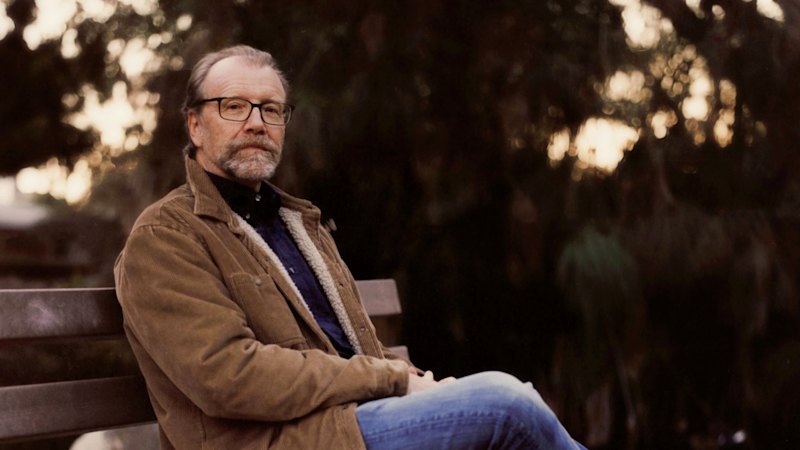
Before George Saunders became literature’s great excavator of the soul, he was blowing holes in the earth for a living. Fresh out of the Colorado School of Mines with a degree in geophysical engineering, he worked in seismic prospecting across Asia for a couple of years.
The job sent him travelling for the first time. In Sumatra, he lived in a base camp deep in the rainforest, a helicopter ride from the nearest town. Back home, his family was struggling after his father’s pizza shop burned down and an insurance technicality meant it could not be rebuilt. One night, while on time off in Singapore, he saw something that would irrevocably shape the reader and writer he was becoming. Was it really that much of a lightbulb moment?
“It really was,” he says, on video call from his home in California, where he has just chuffed down three meatballs after losing track of time due to a hectic day looking after his ageing Labrador Guinevere, mostly known as Gwyn.
The young Saunders, walking home a little drunk by his own admission, passed a hotel development site and saw hundreds of women clearing the ground by hand under floodlights.
“When I saw those women at that hotel foundation, something kicked in. It was almost like I’d wanted to throw my allegiance the other way for some time, but having that objective thing to look at, go ‘wait a minute, I know they’re not getting paid very much, why is the world set up this way?’,” he says.
“Everything fell into line. I started reading more when I was on the crew. I started reading more Steinbeck. It was almost like that incident opened the gate and then all the literature came in and filled it in, and by the time I got home, I was a good anti-Reagan progressive.”
Turning the pages of the decades to now, Saunders is widely regarded as one of our greatest living writers, drawn again and again to the hard-done-by and the overlooked, to people ground down by systems too large to see. Long considered a master of the short story, his first novel, Lincoln in the Bardo, is set over a single night in a Georgetown cemetery as Abraham Lincoln mourns his young son. The story unfolds via a chorus of voices – the audiobook version has 166 narrators, including Julianne Moore, David Sedaris, Jeffrey Tambor and Susan Sarandon – and won the Booker Prize in 2017.
It was on the blurry day after the announcement that I last spoke to Saunders, probably one of dozens of interviews on his itinerary. He says he remembers, and he’s been a practising Buddhist for nearly 30 years, so I should believe him. Even though it’s the sort of white lie you could also expect from a man who developed such a reputation for kindness, in his literature and life.

So nine years on – an essay collection and a volume of short stories later – his second novel Vigil, and our conversation, return to that liminal territory between life and death, and also to Saunders’ early days in the oilfields. The book is set during the final hours of billionaire oil tycoon K.J. Boone, who we find dying, “a tiny, crimped fellow in an immense mahogany bed”. Our guide – and his into the afterlife – is Jill “Doll” Blaine, who died years earlier and has carried out the sacred duty of comforting 343 “charges” as they face death.
But Boone is a tough one. He remains defiant about the damage he has done through his oil empire and by encouraging climate change denial. Spirits arrive hungry for the reckoning he himself resists.
“Part of the mental gymnastics was to say ‘OK, what if I had stayed in the oil business and what if I had gotten really good at it?’. Which I wouldn’t have, but if I had gotten really good, and become an executive, and maybe because I’m so damn charming, I would have become a CEO. Then is it possible that there’s a connection between me and this guy, K.J. Boone? Oh, you know, maybe … if I’d been better at math,” Saunders says.
The novel is also a theological inquiry for the secular age. Is absolution possible for the unrepentant architect of destruction? What does grace look like when weighed against rage for someone who has ruined our world? How much control does a person really have over their choices?
The story is pure Saunders, strange and funny, and there’s a clear link to the Russian masters he loves, especially Tolstoy’s Master and Man and The Death of Ivan Ilyich, with Dickens’ A Christmas Carol, Flannery O’Connor’s A Good Man Is Hard To Find and Katherine Anne Porter’s The Jilting of Granny Weatherall also haunting the lineage.
He’s long been interested in the moment of death. As a child, he remembers worrying about his grandparents’ mortality as he listened to them breathing heavily in their sleep. Even in his oil engineering days, he wrote a story about a man dying, which he now jokes was a Hemingway imitation: “I was doing that thing that young people do where I would just go out and do something and then come back and write it up in a very terse laconic voice.”
He had his own confrontation with death on a United Airlines flight that flew into a flock of geese, which prompted him to reflect even more on how prepared he was.
The setup for Vigil came as Saunders watched a string of terrible weather events unfold across the world and considered who might not even register what was happening because their mindset would not allow it. K.J. Boone rose from there.

“I usually wait for the idea to come back two or three times. It is almost like somebody coming to your house and trying to sell you something. By the third time, you’re like, ‘OK, come in’, so that was it. It was the idea of somebody who had done something quite reprehensible being given a chance at redemption,” he says.
It speaks to familiar issues: corporate greed, environmental collapse and billionaires cushioned from consequences. Saunders says he was walking (writing?) a tightrope between understanding Boone’s mindset and holding it to account. The current climate in America has forced him to grapple with the role of fiction and authors more broadly.
“I’m struggling with this right now for obvious reasons, that if you take a terrible person and examine them thoughtfully through the prism of fiction, I don’t think it hurts anybody. I don’t think it actually enables anybody if you’re good at it, if you’re honest, and if you do a full accounting of the person’s sins.
“But there is a little bit of a built-in distortion field, if you’re narrating from inside the head of a dictator. And if you do a good job, the reader might come to see the dictator’s side of things because to the dictator, he’s not evil, he’s just good, he’s powerful … It’s a question that’s very alive in my mind.”
Despite their differences in scope and scale, Vigil does feel like a spiritual successor to Lincoln in the Bardo. The afterlife here, however, is less rules-based; it’s chaotic, darker and scarier, and there’s no clear way in or out.
“In that way I think it’s a companion piece and maybe what I like about it is it’s almost like two pictures of the same thing but with very different lenses on there, so then there may be a third one, and that would be a different afterlife as well with slightly different rules, and then we have a triptych,” Saunders says.
Part of the mental gymnastics was to say ‘OK, what if I had stayed in the oil business and what if I had gotten really good at it?’
The chaos is part of what makes the novel so fun. Unexplained, unsettling images arrive without explanation. A black calf – perhaps a symbol of displacement, a refugee from a ruined pastoral world – grazes on a piece of Boone’s furniture, a silent witness to his final moments. Saunders says if an unusual image strikes him, he leaves it in at first, trusting that if it’s right, the work will accommodate it.
“I like that calf too, so I left it in there. My thought is, I’m going to go over this book so many times that the rest of the book is going to respond to that image in different ways and justify it or accommodate it,” Saunders says.
“My only litmus test is when I make something like that up, there’s a certain feeling right afterwards. With that black calf, I just went ‘Oh my god, sure, yeah, you’re staying’. Other times, I can sometimes feel that I have contrived it a little bit to fit the theme, and those lines often fall flat, and I just try to take them out right away.”
Saunders has a talent for making the mechanics of fiction feel less forbidding, which explains the following for his Substack, Story Club, where he answers reader questions and sets close reading exercises for more than 325,000 subscribers. It offers a sense of what it might be like to be in his classroom at Syracuse University, where he has taught creative writing since the mid-1990s.
As for a third novel in this loose afterlife sequence, he has an idea and a few sketches, but for now he is waiting to see if it returns, like all the spirits in Vigil and Lincoln in the Bardo.
“I’m going to just think about it and … it’ll come, knocking three times, you know, and then, then I’ll hear it, and then usually I’ll start and see how it goes.”
Vigil is out now via Bloomsbury.
The Booklist is a weekly newsletter for book lovers from Jason Steger. Get it delivered every Friday.