
That first year away from home I had teething troubles adapting to life in Perth and the pressures of law school. I couldn’t focus on textbooks or assignments or anything much at all. Dialogue warbled through to me in a distorted chamber as if I was underwater.
During the summer break, I returned to the wheatbelt town of Narrogin in Western Australia (population 4607; settled 1897). The two-hour drive to Narrogin unfolds like a film. The buildings, palm trees, traffic lights and shops of Perth disappear, the ocean evaporates, the land becomes flat and scraggly with sheoaks, fusing into fields with milling sheep and wheat and wild grass. Barbed-wire fences and paddock stumps resemble Cy Twombly strokes.
Some historians claim the town’s name originated from the Nyoongar description for “place of water”, gnargagin. It is a hub for agricultural services in the wheatbelt, and during the harvest giant mounds of wheat line the horizon in Monet-like pyramids.
My childhood home abuts a forest reserve called Foxes Lair and I trawled its depths with Seva, my 11-year-old brother, spotting echidnas, blue-tongue lizards and galahs. Our Nyoongar neighbours hunted kangaroo and yoked the carcass home on barbecue days. Kangaroo tail was a delicacy, they said – the tender meat falling from the bone. The emptiness of the bush felt like a relief and a release.
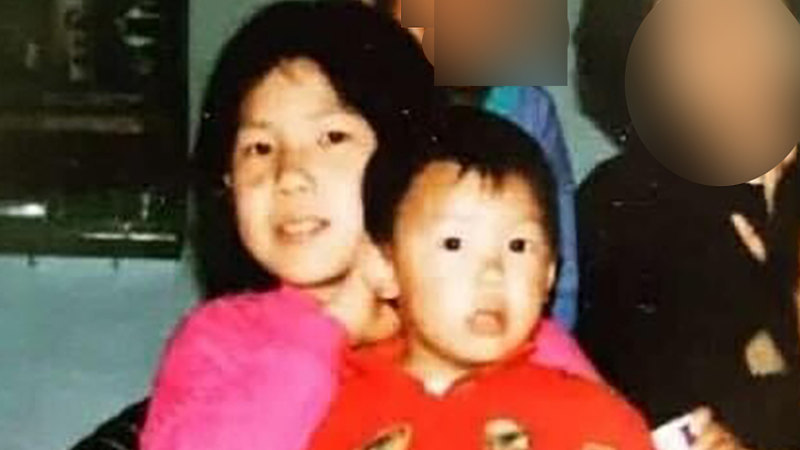
Lily Chan with her brother Seva when they were younger.
My brother favoured long, meandering ambulations. Our favourite landmark was the Narrogin water reservoir. To get to it, we followed a kangaroo trail under a barbed wire fence, along a wide firebreak punctuated by the crackling of ancient gums shedding their barkskins, past an imposing rifle range rearing up like a dual mythological presence, evoking the famed Hokusai print of The Great Wave off Kanagawa and at twilight transforming into the sphinx from The Neverending Story. We passed through the sheoak forest, which was dense with white trunks like ballerina legs, sentinel and silent in deep rows. The grass took on a soft, furred quality, as if the reserve was a giant animal torso and the undulations were its ribs. The water reservoir revealed its midnight depths in the open air – fringed by mallee scrub and swollen and dark with a kind of mystery. Staring into the deep eye of the water reservoir was a brief reprieve from moving through the day like a numb sloth. I was paralysed with anxiety, unable to find the door to adulthood.
My brother generated an easy kind of amiability and contentment except when playing games of any category. Then he transformed into something fearsome and fiercely competitive. There was nothing to be won and lost in the bush, though. He emanated a simple pleasure that I was a dedicated assistant on his makeshift projects.
We collected eucalypt leaves with delicate veins of blush pink. Wattle blossoms with profuse offerings of yellow spores. We poked termite mounds rising among granite outcrops. Stumbled on gumnuts dotting the terrain like bells scattered after a fairy rave. Odd things, too – a desiccated chook carcass in a plastic bag, all feathers and no flesh, like a strange ornamental hat. Grass trees and bottlebrushes, melaleuca and acacia, sudden crops of succulent-like creatures spreading wild arms and emitting dewy carbon dioxide puffs at twilight.

A forest reserve called Foxes Lair, home to echidnas, blue-tongue lizards and galahs, sat directly behind the rural block of Lily Chan’s family.
We built a teepee over three days in a small clearing. It started off small and then grew big enough that we could sit inside. The foliage and sticks framed the sky like stained-glass windows and the sky had a luminous quality unpolluted by urban light. For a moment, we were the only people in the world. Then we headed home and ate cheese sandwiches and emptied the glass vat of honeyed greek yoghurt sitting in the fridge with peeled grapes, strawberries and rockmelon bits bobbing about like sunken treasures.