

“They can learn early on what is a story and what is their reality, without moving to discussions of truth versus lies,” she says.
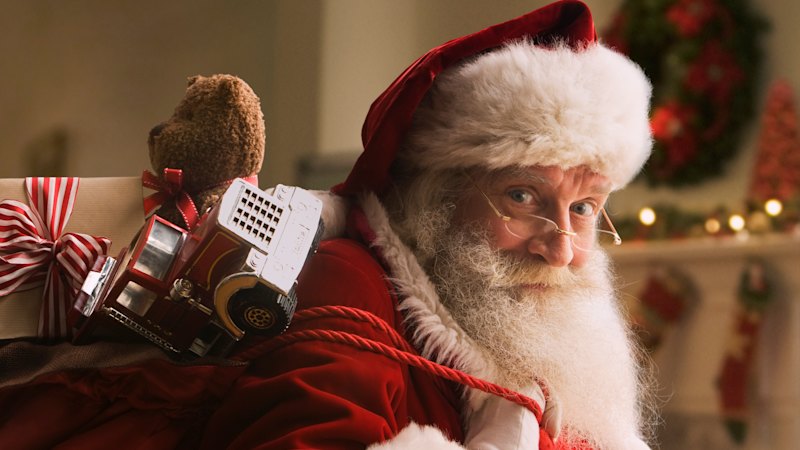
Along with storytelling, magic is also an essential aspect of childhood, something Santa is often part of, says Dr Michael Herd, a clinical psychologist and deputy head of training at Triple P International.
“Magic and wonder can help children make sense of their world and feel connected to cultural traditions,” he says.
“Cultural experiences like Santa that are predictable and repeated provide opportunities for children to add a sense of belonging and connection to family and community. It’s the lovely rituals and things you do together as a family that matter most for a child’s development.”
Discovering the “truth”
Most of us can recall discovering the truth about Santa. For me it was unwrapping presents from my stocking when I was about 10 years old, only to find that I had already seen them in the hiding spot in my mum’s wardrobe beforehand. For my two daughters it was organically through friends, and for other people I know, their parents told them directly.
While these are all common ways kids find out, Herd says there is no perfect time to tell your kids, and both knowing and not knowing each has pros and cons.
“Families who wait until their child is older to share the truth may have a more positive outcome, given their child’s better understanding of the world around them,” he says. “However, some kids might wonder why you kept the secret, or what else you haven’t told them.”
Ultimately, it is a very personal decision based on your family’s values, needs and priorities.
“Parents and carers know their child best,” Herd says.
A major concern for parents who perpetuate the Santa ruse is the fear that their children may no longer trust them when they discover the truth. However, Dr Zena Burgess, chief executive of the Australian Psychological Society, says various studies have shown that children do not trust their parents less after finding out the truth about Santa, and most people do not report high levels of strong negative emotions.
“From those surveyed, children who reported only negative emotions when discovering the truth about Santa were more likely to have found out abruptly and more likely to have learned the truth through testimony from others,” she says.
Loading
While there is no ‘right’ time, Herd says there are signs that your child may be ready to learn the truth, including asking questions like: Is Santa really real? How does he visit everyone in one night?
“Mentioning that older siblings or friends at school have told them the truth [can also be indicative],” Herd says.
“So when your child comes to you to ask, ‘Is Santa real?’, try to give them your full attention and respond with love, calmness and a sense of curiosity.”
The author with her family. They have created their own Christmas traditions.Credit:
Can Christmastime be magical without Santa?
When my youngest informed me that she knew the truth about Santa, I must admit, I was pretty dejected as it felt like a sign that my children were growing up (too) quickly. I also wondered: how will Christmas retain its magic now that the most magical element has gone? Is this even possible?
Burgess believes so.
“For those who celebrate Christmas, there are many other ways to create magic and wonder for children,” she says. “Spending time together as a family is one of the most meaningful ways to celebrate the festive season. Focus on the small moments that make the season feel special and create your own family traditions. This can be as simple as baking treats together, doing an afternoon of craft-making, or taking a drive to appreciate the festive lights on houses.”
My family has made it our mission to ramp up our Christmas activities this year, to ensure we are embracing the Christmas spirit in other ways. This has included Burgess’ advice, including local road trips to see the lights and decorations on people’s homes, watching a Christmas movie every weekend in December, and playing carols in the car.
While it’s not quite the same as Santa, it still makes my daughter’s face light up, and that’s the best magic.
Make the most of your health, relationships, fitness and nutrition with our Live Well newsletter. Get it in your inbox every Monday.