
You have reached your maximum number of saved items.
Remove items from your saved list to add more.
Save this article for later
Add articles to your saved list and come back to them anytime.
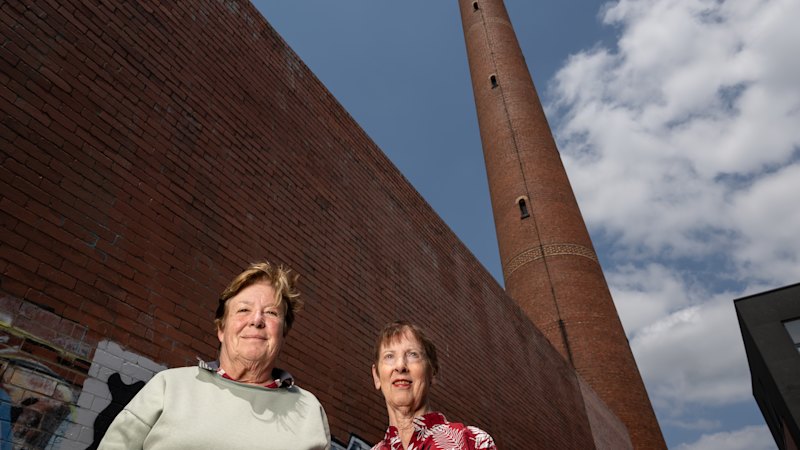
If you’ve ever travelled through Clifton Hill, you’ve probably noticed the skinny brick tower that sticks out like a sore thumb.
Occasionally mistaken for a turret or a giant chimney, this curiously designed, heritage-listed building was previously used to create lead pellets for shotguns.
Standing at 67 metres tall and just 2.5 metres wide, the cylindrical tower was built in 1882 and remains as an early example of the city’s industrial ammunition history.
“The fact that it’s still here is amazing,” said Dale Campisi, a writer who has authored several books about the city’s history.
“It’s a landmark. Everybody that uses the Eastern Freeway … knows that tower. Even if they don’t know what it is, they’re connected to a site that has been there for 140 years.”
The Clifton Hill shot tower is one of two that still exists in the city, with the second, perhaps better known, standing inside Melbourne Central. For a time, both towers were owned by the same family.
Along with a third tower in Tasmania, the trio are thought to be the last left in Australia.
To create pellets, which were also called shot, workers would drop molten lead through a sieve from the top of the tower, which formed into balls as it fell.
The spherical pellets then plunged into a vat of water at the base of the building, which allowed them to cool before workers on the lower floors sorted and distributed them.
The method remained in use until the mid-20th century, when World War II brought significant innovation in the industry and marked the end of production.
President of the Collingwood Historical Society Karen Cummings said the Clifton Hill tower formed an important part of the area’s strong industrial identity.
“It’s a real landmark because you can see it from so many different directions,” Cummings said. “It’s a reminder of the past, and how people made their living in the past.”
Unlike its Melbourne Central counterpart – which is accessible and includes a small museum – the Clifton Hill tower is under private ownership, unoccupied and cannot be entered by the public.
“It’s closed. It’s effectively abandoned. But the structure is still there,” Campisi said.
“It’d be really terrific to see some kind of outcome there where the building is preserved, but ultimately the site is developed as well.”
In October 2024, the tower was defaced with the notorious “Pam the bird” tag – which still remains. With it, an interesting question was raised: who is responsible for the clean-up?
Last year, the alleged graffiti artist was hit with 200 charges and is expected to face court in February.
While the Yarra City Council is permitted to remove prominent graffiti from private buildings, workers can only access surfaces that are less than three metres high.
In serious cases, Heritage Victoria can formally order the owner of a heritage-listed site to make necessary repairs, and in November 2024 the department made contact with the shot tower owner, Phil Kapogiannis.
Kapogiannis told this masthead in March last year that he was working with conservationists to decide how to best deal with the graffiti clean-up.
“Any form of graffiti is taken as neglect,” he said at the time. “So it’s all on our head to fix it and do everything else. It’s not an easy job.”
A Heritage Victoria spokesperson confirmed the regulator has requested, and is still waiting for, proof from the owner that they are working to remove the graffiti.
If no evidence is provided, the body will consider whether a formal enforcement action will be required, the spokesperson said.
Kapogiannis could not be reached for an updated comment.
Cummings said she and other volunteers from the local historical society are unhappy that the prominent graffiti is still on the historically significant tower.
“The only good thing about it is that you can only see it from one direction,” she said.
“What would be nice is if people who go around defacing things had a bit more appreciation for what’s there.”
Start the day with a summary of the day’s most important and interesting stories, analysis and insights. Sign up for our Morning Edition newsletter.
You have reached your maximum number of saved items.
Remove items from your saved list to add more.