
On May 5, 1965, producer Lee Mendelson took a phone call from John Allen at the advertising agency McCann Erickson, asking whether Mendelson and his collaborator, Peanuts creator Charles Schulz, had considered making a Christmas-themed television special set in the Peanuts universe.
“Of course,” Mendelson told Allen, before hanging up and calling Schulz. The truth? They had not. The challenge was that Schulz had always resisted overtures from Hollywood to turn his two-dimensional cartoons into living colour animation. Whenever fans wrote letters asking, Schulz famously replied: “There are some greater things in the world than TV animated cartoons.”
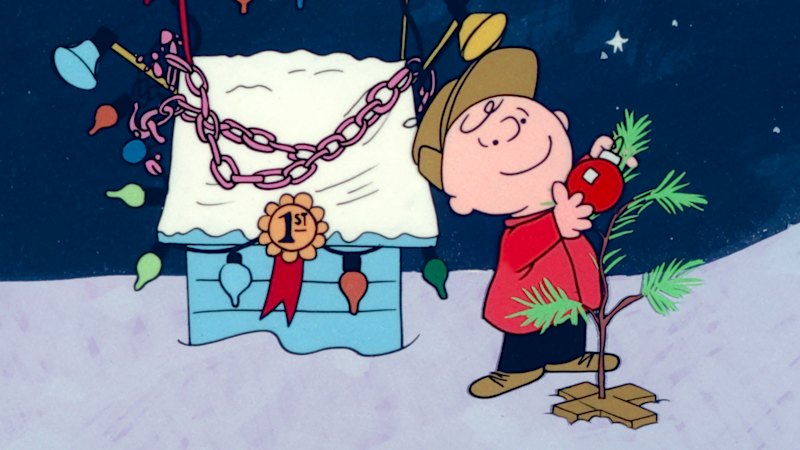
A scene from A Charlie Brown Christmas.Credit: Peanuts Worldwide
It is perhaps deeply ironic, then, that 50 years after the proposed cartoon Christmas special was produced, there is no greater thing in the canon of Christmas-themed television than the special that resulted from Mendelson’s call with Allen: A Charlie Brown Christmas.
Peanuts, which was created as a syndicated daily and weekend newspaper comic strip and written and illustrated by Charles M. Schulz, began its life as Li’l Folks, published in Schulz’s hometown newspaper, the St Paul Pioneer Press, from 1947 to 1950. Inspired by the kids’ TV show Howdy Doody, whose studio audience were known as “the peanut gallery”, Schulz’s band of ordinary American kids were re-christened Peanuts.
Loading
The Peanuts universe is centred around Charlie Brown, an awkward everyday kid who lacks self-confidence. His peer group includes his pet beagle Snoopy, bossy Lucy van Pelt, and her thoughtful, security-blanket dependent brother Linus, tomboy Peppermint Patty, Patty’s bookish but wise best friend Marcy, Charlie’s younger sister Sally, piano-playing, Beethoven-obsessed Schroeder (with whom Lucy is infatuated) and a chorus of other kids including Shermy, Franklin, Pig-Pen, Violet, Patty and Frieda.
What set Peanuts apart from other comic strips was the way it explored the inner emotions of the children, but notably Charlie Brown’s grappling with profound philosophical, psychological and sociological questions, usually punctuated with observations from the pragmatic Lucy or the more thoughtful Linus.
Its place in the Christmas canon came off the popularity of Christmas movies, the most obvious staple of the genre: everything from It’s a Wonderful Life (1946), perhaps the most powerful and enduring Christmas movie of all time, to Home Alone (1990), the most festive, brilliant take on a Christmas film in the modern cinema canon. Honourable mentions: A Christmas Story (1983) and National Lampoon’s Christmas Vacation (1989).

The Peanuts gang in A Charlie Brown Christmas (left to right): Three and Four, Sally Brown, Five, Snoopy, Lucy van Pelt, Charlie Brown, Violet, Frieda, Shermy, Linus van Pelt, Schroeder, Pig-Pen and Patty.Credit: Apple TV+
That pantheon might also include Die Hard (1988), even though its inclusion in the Christmas canon is still hotly debated. The case against: it is not an intrinsically Christmas-themed film. The case for: it takes place at Christmas, and involves a man climbing down an air duct to save everyone. Sure sounds like Christmas. On the same algorithm, does that make Tim Burton’s Christmas-set gothic masterpiece Batman Returns (1992) also a Christmas film? It quite possibly does.
Loading
The ubiquity of television in the mid-20th century also played a role in shaping the Christmas TV canon. In the 1960s the production company Rankin/Bass Animated Entertainment turned beloved stop-motion specials into a fine art, with Rudolph the Red-Nosed Reindeer (1964), The Little Drummer Boy (1968), Santa Claus Is Comin’ to Town (1970), The Year Without a Santa Claus (1974), The First Christmas (1975) and others.
And British television famously spun Christmas-themed episodes off its most popular series. Not, as is the custom in the US, to be aired in the natural sequence of episodes in late November or early December, but as standalone Christmas-themed episodes, which air on Christmas Day or Boxing Day. Best examples: Doctor Who, Downton Abbey, Gavin & Stacey and others.
In a sense, Christmas television as a staple is born out of the climate: northern hemisphere cultures where these shows were created have their Christmas in winter, a season which tends to encourage people to stay indoors and gather around the television. In Australia, where the sound of tennis and cricket on the television is as much a staple of Christmas TV as Carols by Candlelight, Christmas tends to be a more outdoor event, with a slightly more tenuous relationship with the TV.

“Christmas is coming, but I’m not happy. I don’t feel the way I’m supposed to feel.”Credit: Apple TV+
The streaming era, however, has transformed that relationship. Now, historic and classic Christmas specials are available at our fingertips, either via streaming platforms such as Apple TV or Disney+, or indeed YouTube, a somewhat lawless wilderness where the strange, the esoteric and the often-thought-lost fall through the cracks and land in a nearby stocking.
And it is there, perhaps, in a storm of Hallmark-produced films notable for one-note characters and cheesy plot lines, and this year’s antidote to that – the Family Guy special Disney’s Hulu’s Family Guy’s Hallmark Channel’s Lifetime’s Familiar Holiday Movie, available on Disney+ – that somehow A Charlie Brown Christmas endures, not just as a charming Christmas classic, but as a polemic on navigating the complexities of modern life.
Loading
In it, Charlie wrestles with the great themes of Christmas: its purpose, its relationship with crass commercialism and the struggle to find something substantial in a world propelled by an appetite for the pretty and superficial.
“There must be something wrong with me, Linus,” Charlie says. “Christmas is coming, but I’m not happy. I don’t feel the way I’m supposed to feel. I just don’t understand Christmas, I guess. I like getting presents and sending Christmas cards and decorating trees and all that, but I’m still not happy. I always end up feeling depressed.”
That was certainly a tough pill for the TV executives to swallow when the special was delivered to the US network CBS. To quote Michael Keane, who chronicled the journey of the special in his book Charlie Brown’s Christmas Miracle, they had “almost certainly expected another Rudolph, The Red-Nosed Reindeer but instead of Santa Claus, reindeer, elves and traditional holiday music, they had been served up a buffet of Bible study, holiday angst and a searing attack on commercialism.”

One little boy’s soliloquy: “Isn’t there anyone who knows what Christmas is all about?”Credit: Apple TV+
Collectively, they all held their breath for the TV review that mattered most at the time: the verdict of Time magazine’s Richard Burgheim, a notoriously tough critic, having just fired off a review of the new TV season that included the line “deplorable, hackneyed, timid and banal”.
Loading
But like a Christmas blessing, Burgheim was charmed by A Charlie Brown Christmas, partly because of the decision to use real kids’ voices to accompany Bill Melendez’s magnificent animation, rather than stage kids. “A Charlie Brown Christmas is one Christmas special this season that bears repeating,” Burgheim said. If only he had known just how prophetic that statement was. It has been repeated every year since, released on DVD and is now cast in the immortal library of streaming.
And as for little Charlie Brown, who finds no answers in his consultations with commerce and decoration-obsessed Snoopy or Lucy? It takes the innocence and profound wisdom of Linus to explain the meaning of Christmas to him. That Peanuts survives 75 years after its inception is testament to the brilliance of Charles M. Schulz. That A Charlie Brown Christmas can still move me to tears, 50 years after its premiere, is down to a little kid named Linus.
A Charlie Brown Christmas is now streaming on Apple TV.