

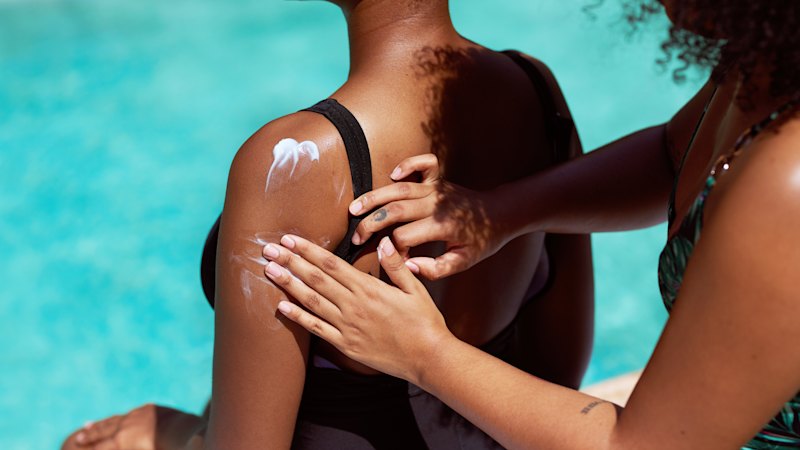
The TGA declined to comment on the claims from the ABC, telling this masthead: “The TGA does not generally comment on individual investigations or compliance actions until they are concluded, as doing so may compromise the investigation.
“We are, and will continue to be, as open and transparent as possible and update our website with information for consumers of our findings and any actions that we are taking.”
Sunscreen recalls to date
Sunscreens recalled for lower than claimed SPF levels:
- Aspect Sun Physical Sun Protection SPF50+.
- Aspect Sun Tinted Physical SPF50+.
- Aesthetics Rx Ultra Protection Sunscreen SPF50+.
- Ultra Violette Lean Screen SPF 50+.
- people4ocean SPF50+ Mineral Bioactive Shield Lightly Tinted Cream – 10g and 45g.
- BEAUTI-FLTR Lustre Mineral SPF 50+ Illuminating Facial Sunscreen.
- MCo Beauty SPF 50+ Mineral Mattifying Sunscreen.
- Outside Beauty & Skincare SPF 50+ Mineral Primer.
- Salus SPF 50+ Daily Facial Sunscreen.
- Naked Sundays Collagen Glow 100% Mineral Sunscreen SPF50+.
- New Day Skin Happy Days SPF 50+ Daily Face Cream.
- New Day Skin Good Vibes SPF 50+ Daily Face Cream.
- Found My Skin SPF50+ Tinted Face/Body Cream.
- We are Feel Good Inc Mineral Sunscreen SPF50+ 100g Cream.
- The Fountain of Youth Environmental Defence Cream SPF50+.
- Ethical Zinc Daily Wear Light Sunscreen SPF50+.
- Ethical Zinc Daily Wear Tinted Facial Sunscreen (Light) and Daily Wear Tinted Facial Sunscreen (Dark).
- Endota Mineral Protect SPF50 Sunscreen.
- Allganic Light Sunscreen SPF50+ 70g – Baby & Kid Sunscreen.
Separate sunscreen recalls, due to the potential for the product to become separated:
- Cancer Council Sunscreen Clear Zinc Kids SPF50+ 110g (affected batch numbers 1143730, 1141313 and 1146857).
- Bondi Sands Zinc Mineral Broad Spectrum UVA & UVB Protection Sunscreen SPF 50+ Face Lotion 60ml (affected batch numbers GC032084 and 4843).
- Bondi Sands Zinc Mineral Broad Spectrum UVA & UVB Protection Sunscreen SPF 50+ Body Lotion 120ml (affected batch numbers GC032114, GC063314 and 4844).
Mineral v chemical
When shopping for sunscreen, you will find they are marketed as either mineral or chemical. The difference comes down to the active ingredients they contain – in other words, the type of ingredient that makes a sunscreen, a sunscreen, and filters out harmful sun rays.
For mineral, or physical, sunscreens, the active ingredients are called inorganic compounds, typically titanium dioxide or zinc oxide. Given these are physical particles, mineral sunscreens are often heavier and can leave a “white cast”, although technological advancements, like “nanoparticles” of minerals and added ingredients can make them apply more smoothly.
For chemical sunscreens, active ingredients are organic compounds that can include octinoxate, avobenzone, bemotrizinol and homosalate.
It’s often thought that mineral sunscreens reflect harmful sun rays, whereas chemical sunscreens soak them up. But in reality, both chemical and mineral sunscreens work by absorbing UV light.
Are mineral sunscreens more unstable?
So, given the majority of sunscreens that have been recalled this year, or had their SPF claims called into question, have been mineral, are they less reliable than their chemical counterparts?
Loading
Not necessarily, says cosmetic chemist Dr Michelle Wong.
However, she says titanium dioxide and zinc oxide particles are heavy and dense, and have a tendency to separate from, or sink to the bottom of sunscreen formulas, usually made of water and oil which are lighter by comparison.
Since these formulas tend to be less pleasant to apply, she suspects many people may not be applying enough to reach the listed SPF.
But Wong points out sunscreen formulation as a whole, can be complex and volatile, and that many of the sunscreens that returned lower than listed SPF levels according to CHOICE’s testing were chemical.
Dr Yousuf Mohammed, an associate professor at The University of Queensland’s School of Pharmacy and Pharmaceutical Sciences, agrees that mineral sunscreens can be susceptible to separation issues due to the density of zinc or titanium particles.
“My take is that zinc sunscreens should not be made in SPF50 because to get to SPF50 you actually need to load a very high quantity of zinc, more than 30 per cent sometimes, and it’s almost like you’re putting a rock in a glass of water – it’s going to sink,” he says.
If you do want to use a mineral sunscreen, he recommends opting for one with SPF30.
“SPF30 is enough. If you look at the sun protection difference between SPF30 and 50, there’s only a 1 per cent difference. So SPF30 allows about 1/30th of UV radiation through, or [stops] 97 per cent [of UV radiation], and SPF 50 is 1/50th, which is 98 per cent, so there’s not much of a difference.”
A spokesperson for the TGA told this masthead: “There is no evidence that mineral sunscreens are inherently less stable; recent recalls have been linked to specific issues with certain formulations as published on Market actions, and do not reflect the entire category.”
“All sunscreens, whether therapeutic or cosmetic, mineral or chemical, must comply with the Australian/New Zealand Standard for sunscreens 2604.”
‘Natural’ mineral sunscreen
Over the past few years, mineral sunscreen has risen in popularity, in large part due to fears around the “toxic” chemicals in chemical sunscreens.
Two such chemicals to have elicited controversy are oxybenzone and homosalate, common UV filters in chemical sunscreens.
Part of the reason for the concern, says Mohammed, is that chemical sunscreens contain smaller particles and penetrate the skin, whereas mineral sunscreens tend to sit on the surface of the skin. Some studies have found sunscreen ingredients in the bloodstream and urine.
Loading
However, research on whether these chemicals have harmful effects on humans is still unclear, and so far most research has been done on animals or cells. Some research suggests they may act as endocrine disruptors, however there is no scientific consensus.
Wong says that to be approved for the market, companies expose subjects to far higher levels of certain ingredients than products contain in order to register an effect. The level at which consumers are exposed to these ingredients are far lower.
One scientific review published last year found no evidence that six common UV filters affect DNA or cause cancer, and that blood concentration levels fell far below what might register an effect.
She also points out the minerals in physical sunscreens are highly processed, and so “far from natural”.
While Mohammed agrees research is still emerging, he is more cautious about the potential effects of some of these chemicals.
“The exposure is definitely there. It’s really high.”
He believes that “sooner or later the science will catch up”, and it’s better to err on the side of caution.
“We don’t want to wait until it becomes another case of silicosis or asbestos.”
Many regulatory bodies around the world have introduced limits around some of these ingredients.
In 2021, the European Commission Scientific Committee on Consumer Safety lowered the percentage of UV filters oxybenzone, homosalate and octocrylene permitted in cosmetic products.
In August, the TGA urged dozens of popular sunscreen manufacturers to reformulate their products to add safeguards concerning oxybenzone and homosalate following an internal review found they were at a lower margin of safety when using the highest-estimated sunscreen exposure for application.
However, they did not say this meant Australian sunscreens containing these ingredients were unsafe, nor did they instate any ban, recall or warning in relation to the review.
The TGA acknowledged available scientific data is not yet “adequate to derive a conclusion as to their causality in humans”.
One in three ‘mineral-only’ sunscreens found to have similar ingredients to chemical sunscreens
Last month, researchers from The University of New South Wales took 143 sunscreens listed on the TGA website where zinc or titanium oxide were identified as the only active ingredient.
Then, they scanned the full ingredient list for other compounds that might also be used to filter UV light.
They found that one in three “mineral only” sunscreens contained UV filtering chemicals not listed as active ingredients.
In Australia, sunscreen brands are only required to declare the active ingredients in a product.
However, Dr Jon Beves, a professor at the UNSW’s School of Chemistry who worked on the report, says they found “many of the sunscreens that are marketed as mineral sunscreens, where the only listed active ingredient is zinc oxide, contain loads of other chemicals that are very similar to the chemicals you’d find in all the other types of sunscreens.”
What this means, says Beves, is most mineral sunscreens are only nominally different from chemical ones.
“Sunscreens are high-tech products. Even ones that are listed as being ‘chemical-free’ or ‘all-natural’ or any of this other sort of nonsense, they have to be formulated with other things mixed in them, otherwise they wouldn’t act as sunscreens. It’s just marketing lingo,” he says.
Mohammed agrees that undeclared additives in mineral sunscreens is a problem, and urges consumers to do their due diligence around sunscreen ingredients if they are concerned about certain additives.
How is sunscreen tested?
The current standard for SPF testing in Australia involves putting sunscreen on a minimum of 10 human volunteers who are exposed to artificial solar UV radiation to minimise the variability of sunlight. The higher the SPF, the longer it takes UV radiation to burn skin.
Due to the use of human subjects and human testers to judge the level of burn to the skin, the method is highly variable, something acknowledged by the TGA and experts.
In December last year, the International Organisation for Standardisation (the guidelines which the TGA follows) published two novel methods for measuring SPF, which may reduce the inherent variability of the current model of sunscreen testing. But it is not yet known when this might become available or standardised in Australia.
So, what sunscreen should you use?
At the end of the day, the best sunscreen is the sunscreen you will use, says Wong. Whether this is a mineral or chemical sunscreen comes down to personal preference – some may prefer the thicker, drier formula of physical sunscreens, or be more sensitive to the ingredients in chemical sunscreens.
Loading
And correct usage of sunscreen is just important as the product you choose: “Most studies have shown that most people do not apply enough sunscreen to get the labelled SPF,” says Wong.
Australian guidelines for sunscreen recommend applying one teaspoon per limb, one for the front of the body, one for the back and one for the head. They also recommend wearing sunscreen every day when the UV index is above 3 (in Australia, most days of the year).
While the spate of sunscreens returning lower SPF ratings than their labels claim is obviously a concern, it’s worth remembering that even a lower SPF rating provides significant protection. A landmark Australian study from 1990 using an SPF16 sunscreen was the first to prove that regular sunscreen use can prevent melanoma.
Additionally, sunscreen is just one line of defence against the sun: remember the Cancer Council’s Slip, Slop, Slap, Seek, Slide slogan.
Wong also suggests keeping an eye on the TGA website for recalls. If your sunscreen is affected, stop using it and seek a refund.
Finally, Wong says to use common sense: if you are getting sunburnt, make sure you are applying enough and regularly, or consider using a different sunscreen.
Make the most of your health, relationships, fitness and nutrition with our Live Well newsletter. Get it in your inbox every Monday.