
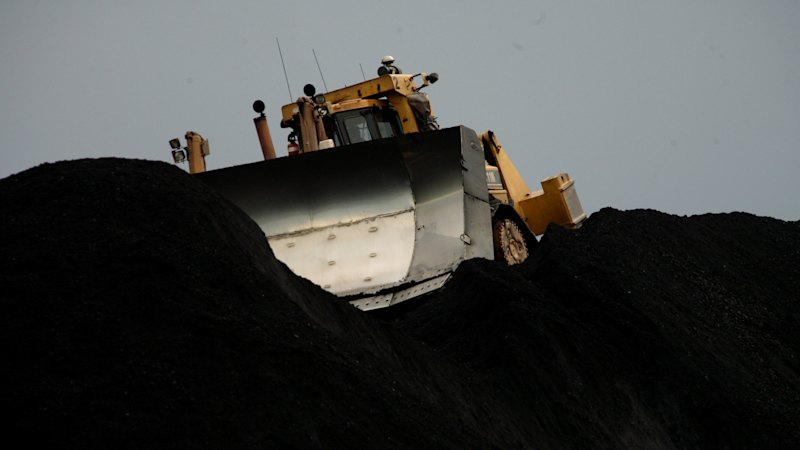
The Cook government has reneged on a pledge to halt taxpayer-funded subsidies to prop up failing Collie coal miner Griffin Coal.
WA Premier Roger Cook and Energy Minister Amber-Jade Sanderson visited Collie on Wednesday, where they announced a five-year extension of the Griffin coal state agreement which will see taxpayer subsidies continue beyond June this year, despite previously promising to turn off the tap.
A $308 million fund has been available for Griffin to draw down on so it could keep supplying the major coal-fired power stations in Collie.
Cook said the extra funding available to Griffin over the next five years would be “significantly less” than the $308 million already committed because the coal miner was negotiating better prices for its coal with large customers like privately owned power station Bluewaters.
“What we did is went down and sat down with Bluewaters, with Griffin, their customers, to demand that they come to commercial terms in relation to the arrangements they have right across the system,” she said.
“I can report that those conversations have gone very well and that we are substantially in that position.
“When you look at the fact that we’ve spent over $300 million since 2022, we will see a significant and drastic reduction to the support and the role that the government will play in this area.”
Cook would not reveal specifics of the deal – only that the details would be revealed to parliament once the commercial arrangements are finalised.
Opposition energy spokesman Steve Thomas said the announcement was the inevitable outcome of 10 years of mismanaging the state’s energy system.
“This is an acknowledgement of the failure of its current transmission plan, and also a long-term mismanagement of the Collie coal fields,” he said.
“We’ve absolutely understood now for years that you’re going to need coal generation to get you through to a proper transition.
“We’re also going to need additional gas. We’ve also known that the economics of coal is difficult, but we’ve mismanaged the coal fields for a decade.”
Greens WA energy spokesman Brad Pettitt said Labor had failed to properly invest in renewable energy, and it was “absurd” that taxpayers were now being forced “to subsidise a foreign-owned company for another five years in the middle of a climate crisis”.
“This must be a wake-up call for the Cook Government to set a serious 2030 renewable energy target and roll out new transmission at speed to ensure that renewable energy is well placed to replace coal-fired power when state-owned coal closes in 2030,” he said.
“Throwing good money after bad outcomes will only further slow down the pathway to achieving net zero; the sooner all coal, not just state-owned coal, closes in WA, the better.”
The WA government plans on shutting down all of its state-owned coal power stations by 2030.
Cook announced a Collie basin transition taskforce would be established to develop a detailed proposal on the future structure of the coal assets in the basin which included investigating whether Griffin Coal and fellow Collie coal miner Premier Coal should merge.
The taskforce will report back to Cook within 6 months.
Sanderson said the government remained committed to exiting state-owned coal by 2030.
“Coal assets are becoming less reliable and are ageing, particularly the state-owned coal assets,” he said.
“It will become increasingly expensive to continue to run those assets.”
“We know that renewable energy, backed by gas and storage, is the least cost mix, and that is the mix that we’re working towards.
“The transition is working. The transition is complex, but to give you an example, yesterday, we peaked at around 303,800 megawatts of demand, 20 per cent of that was delivered by batteries.”
A $220 million package was first announced in December 2023 to avoid the shutdown of Griffin Coal’s mining operations in Collie.
The $220 million package was on top of $40 million in support payments already paid to Griffin and late last year Cook increased the money available to $308 million after it became clear Griffin was drawing down on the funding quicker than the state expected.
The Indian-owned company entered receivership in 2022 following escalating losses on the fading operation and crippling debts that reached about $1.5 billion.
Cook told parliament in May last year he intended to cease funding Griffin by June this year and had reached out to stakeholders to find out what their plan was after taxpayer support ended.
As late as December, Labor reiterated it would not offer any more taxpayer money to Griffin beyond June 30, 2026.
“The government has previously stated that it expects the continuation of the mine to be on a commercial basis,” leader of the upper house Stephen Dawson told Parliament on December 11.
“The government is currently in discussions with commercial parties to determine what should occur after 30 June 2026.”
In response to questions in parliament, Dawson said the $308 million was the maximum amount that would be spent to prop up Griffin with a caveat: “Yes – based on current forecasts.”
As of December 11, $209 million had been transferred to Griffin.
Be the first to know when major news happens. Sign up for breaking news alerts on email or turn on notifications in the app.
 Hamish Hastie is WAtoday’s state political reporter and the winner of five WA Media Awards, including the 2023 Beck Prize for best political journalism.Connect via Twitter or email.