

Masterclass
The biggest question – when?
The last time I made a great Caprese salad was at the end of last summer, using homegrown tomatoes I’d ripened on a sunny shelf for about two weeks.
While you don’t need to grow your own, a great Caprese salad is all about curation.
The best recipes from Australia’s leading chefs straight to your inbox.
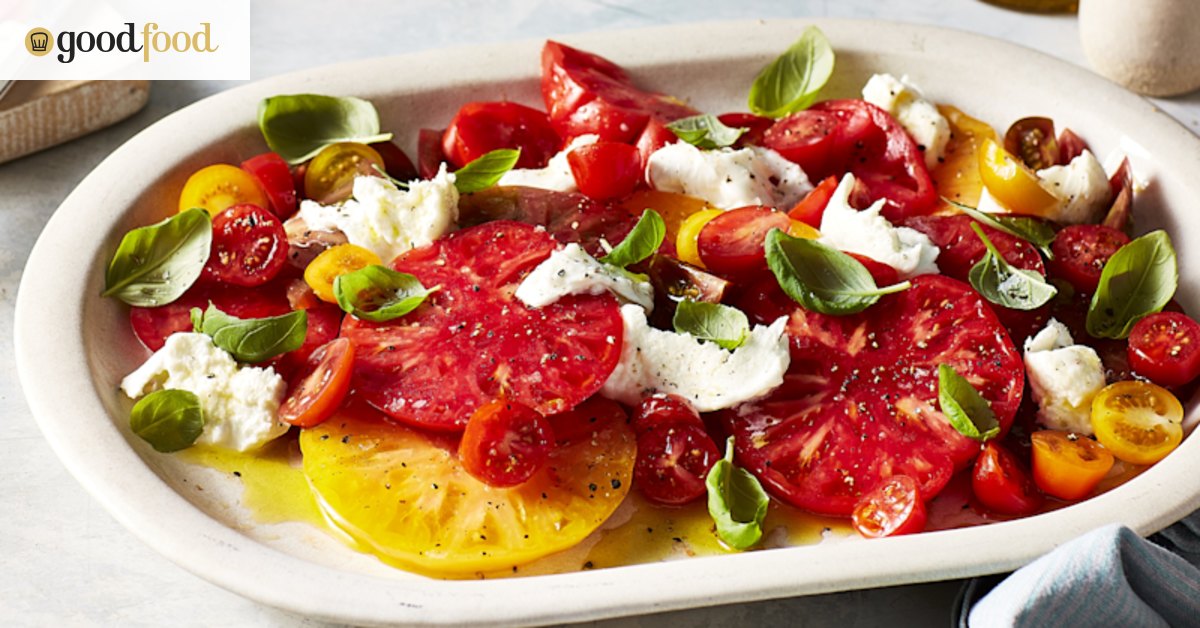
Right now, you’ll find all kinds of excellent tomatoes at greengrocers and farmers’ markets. Using a mix of different types adds a beautiful layer of complexity through contrasting colours and flavours.
Ultimately, this salad isn’t about complex cooking – it’s about choosing excellent ingredients and letting them shine. But if you want to make a Caprese salad in the middle of winter, be my guest.
Can you refrigerate tomatoes?
In tomatoes, the genes that produce certain flavour compounds are turned off by cold temperatures and never recover. This has led to the popular rule, “Never refrigerate tomatoes”. It’s not quite as straightforward as that.
One of the primary flavour compounds in tomatoes affected by refrigeration is Cis-3-hexenal. This grassy-smelling aroma compound eventually breaks down into the sweeter trans-2-hexenal (also known as leaf aldehyde). This chemical process is responsible for the signature “green” aroma found in many fresh produce staples, including kiwifruit, Granny Smith apples, cucumbers and capsicums.
In a commercial context, ripe tomatoes are often too delicate to transport. To solve this, they are picked hard and green, then “ripened” with ethylene gas.
While ethylene is the same gas that fruits naturally release to ripen, this artificial exposure primarily triggers cosmetic changes. It turns the tomato red without developing the complex flavour molecules found in vine-ripened fruit. The result is a tomato that looks perfectly ripe but remains chemically under-ripe and flavourless.
While people often blame refrigeration for flavourless tomatoes, the real culprit is a lack of genuine ripeness. The inconsistency is clear: we rarely hear warnings against refrigerating kiwifruit, apples, or capsicums, although they share similar aromatic compounds.
Maximising tomato flavour is remarkably simple: keep them out of the fridge until they are fully ripe and even slightly soft. Once they reach their peak, you can refrigerate them to slow the ripening process so they don’t spoil too quickly.
When you’re ready to eat, remove the tomatoes from the fridge for an hour or two to return to room temperature. This step is mostly for texture rather than flavour. Side-by-side taste tests of tomatoes that were refrigerated after reaching full ripeness show that the cold has little impact on their taste.
Mozzarella
For the best results, use soft, fresh mozzarella rather than the firm, semi-dried kind used for pizzas. Look for white balls stored in whey. While purists prefer buffalo mozzarella (mozzarella di bufala) for its tangy, creamy depth, it can be both expensive and elusive. If you can’t find it, cow’s milk mozzarella (known as fior di latte) is a widely available and excellent alternative for a Caprese salad.
The olive oil problem
The biggest problem with good olive oil is that people don’t use it. Many people treat a premium bottle like a fine wine, tucking it away for a “worthy” occasion that never seems to arrive. By the time they finally break the seal, the oil has likely lost its best qualities.
Olive oil is a fresh product that begins to degrade the moment it is pressed. Exposure to air and moisture can turn it rancid within four months of opening, and even a sealed bottle will lose its vibrancy after about 18 months.
Much like corked wine, many people fail to notice when olive oil has gone rancid because the flavour isn’t immediately “rotten” in a traditional sense.
Instead of the sharp repulsion of spoiled meat, rancid oil develops a flat, waxy profile reminiscent of plasticine. (For comparison, corked wine takes on a dull, musty scent like wet cardboard.) But also like corked wine, once you start noticing it, you won’t let the good oil languish on a shelf again. To get your money’s worth, the best rule is to use it generously and often.
Where’s the balsamic?
While many recipes for Caprese salad call for a drizzle of balsamic vinegar or glaze, I skip it. If you season your tomatoes well and follow the methods I’ve outlined, you’ll find all the flavour you need is already there. That said, I’m not a purist who views a splash of vinegar as a grave offence to my heritage or the Roman Empire.
The sweet, tangy profile of balsamic can be a lovely addition, especially if your tomatoes are under-seasoned or a bit lacklustre. If that’s how you enjoy your Caprese, please don’t let me – or anyone else – stop you.
I’ve done my best to explain the traditions, science and techniques behind a great salad. But ultimately, the best salad is the one you enjoy eating the most.