
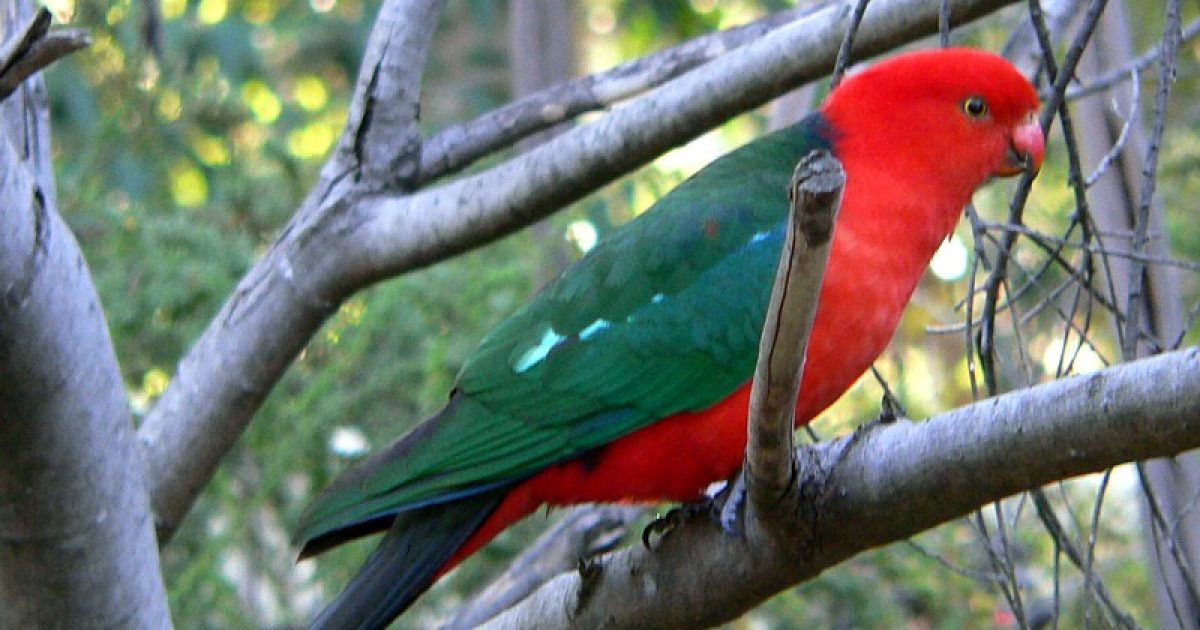
Male King Parrot in a Canberra backyard. I love those pale green flashes in the wings. Photos: Ian Fraser.
At this time of year, there are relatively few King Parrots in Canberra, but the numbers are already rising.
The first are starting to come down from the mountains, having bred in hollows in big eucalypts in the wet forests, to join those non-breeders who spent summer down here.
They are truly spectacular big parrots, especially the adult males, which are startlingly red and green. The head and undersides are a bright red, like the pillar-boxes we used to post letters in the suburbs, while the wings and tail are rich bottle green with a couple of striking pale green flashes in the wing. Females are rather more demure, with a red tummy and somewhat duller green elsewhere.
They tend to be a bit less approachable than Crimson Rosellas, but where they are regularly fed they can become very tame indeed. In autumn, large flocks of young birds, freshly down from the mountain forests, will gather to feed at food sources such as fruiting trees. These included an old quince tree, famously by the now vanished pub at the Cotter crossing, victim of The Fires of 2003.
They also feed more traditionally on eucalypt and wattle seeds, native berries and seeds.
Once, when my father was visiting from Adelaide, he expressed the wish to see some, and with some local knowledge (which I was still in the process of obtaining), we found a flock feeding on fallen Pin Oak acorns in Yarralumla. They often have to share these with Sulphur-crested Cockatoos, which also appreciate such offerings in place of more natural foods that they no longer have access to.
I was browsing recently in a largely forgotten local classic bird book, the 1969 Birds in the Australian High Country, edited by Harry Frith, a giant of Australian bird studies and, at the time, leader of the CSIRO Wildlife Research team, and illustrated by the supremely gifted bird artist Betty Temple Watts.
(Frith drew on contributions from a cornucopia of local bird doyens, including many of his CSIRO colleagues; this was in the sadly long-gone days when CSIRO was allowed to set its own research priorities and ‘pure’ research was not frowned upon.)
Anyway, I was interested to read that at the time “fully-coloured males are rarely observed in Canberra”. This is certainly no longer true; in fact, I have only to look out the window at present to see one. This is a direct result of Canberra’s growth, with its gardens and parks providing good food sources.
There have long been occasional breeding records from Canberra. However, these are still uncommon, partly because the parrots are notoriously shy when breeding, but more importantly, because of the continual loss of mature eucalypts with breeding hollows.
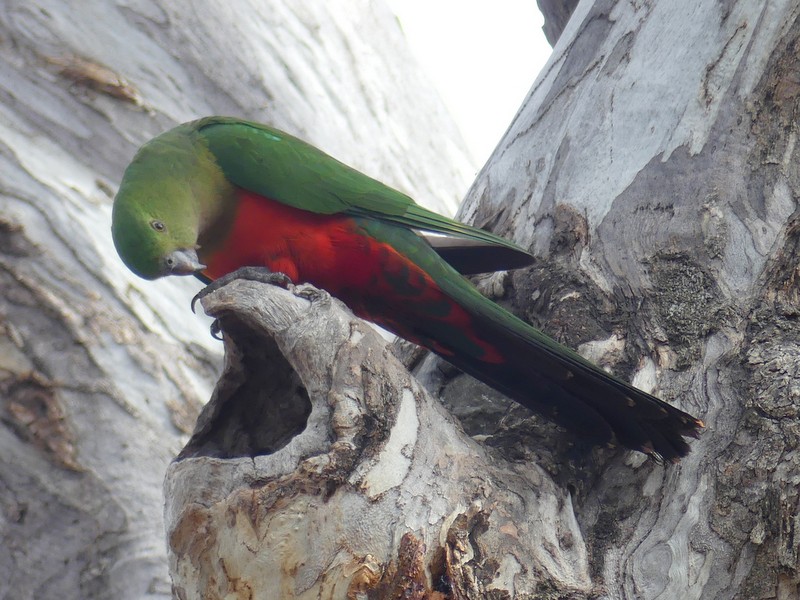
Female King Parrot inspecting a nesting hollow at Mulligans Flat.
One historical King Parrot name I came across while working on a past project on Australian bird names was Spud Parrot, reported in 1918 from Victoria, “as they attacked the potatoes when dug and lying on the ground”.
And speaking of names, ‘King Parrot’ itself does not mean what it seems.
George Caley was sent to Australia in 1800 by Sir Joseph Banks to collect plants, and he also returned animal specimens that came his way.
Among these was a bird which he called ‘King’s Parrot’ for Governor Philip Gidley King. It didn’t take long, however, for this connection to be forgotten, and the apostrophe soon disappeared.
In John Gould’s definitive, mighty work on Australian birds in 1848, he was quite unaware of the original name. And while I don’t expect most people to be interested in the scientific name, there’s a story here too!
Gregory Matthews, the hugely influential, self-taught and erratic Australian ornithologist (working in England), was notorious for naming birds for his friend and family.
On one occasion, in 1911, he coined the name Alisterus for the King Parrot, for his then four-year-old son Alister.
However, as ever, the birds are the most interesting part of the story.
So next time you’re out and about, listen for the shrill, hard whistles and watch for the flash of red and green of the King Parrots.