
You have reached your maximum number of saved items.
Remove items from your saved list to add more.
Save this article for later
Add articles to your saved list and come back to them anytime.
It’s always a bummer when the last weekend of January rolls around and the Australian Open finishes for another year. When the tennis ends, the year’s honeymoon is officially over. Real life is back in session. Suddenly, the idea of sitting on the couch watching eight straight hours of tennis, or anything else, seems laughably unrealistic, not to mention a little depraved.
What I’m mainly going to miss about the tennis isn’t the actual tennis, which this year was patchy. What I’m mainly going to miss is the commentary – the pearls of analysis from the ex-pros in the bunker. If you listened carefully to their words of wisdom, you could pick up a nightly serve of free life hacks that would, if you’d heard them from a licensed motivational guru, have cost you thousands of bucks.
Jim Courier has been coming to Australia to call the tennis since 2005. Since 2019, he’s been working for Channel Nine, owner of this masthead. As a player, Courier was always something of an enigma. As a commentator, he ranks with the best there have ever been. He isn’t just a first-rate tennis mind. He’s a first-rate mind full stop.
Jim’s chief gift is to translate the action into layperson’s terms. Forget about torque and topspin. What the players are mainly doing out there is problem-solving. Each point, each ball, is a new problem. “He’s solving problems out there,” Jim will say. Or else he’s not solving problems out there, which means he might be on the way to getting “bagelled”.
When Jim talks like this, he’s giving you stuff you can use on a day-to-day basis, on the hardcourts of real life. Don’t let your problems bagel you. Solve them one by one. Play the ball; don’t let the ball play you. You may get beaten out there, but don’t let it be because you’ve beaten yourself.
Late in his tennis career, while playing a crunch match at the ATP finals, Courier did something famously strange at the changes of end. Instead of staring into space eating a banana, he sat there reading a novel: Armistead Maupin’s Maybe the Moon. At the time, this was widely viewed as a sign that Jim was losing it. In retrospect, one sees that he was prepping for his second career as the world’s leading tennis intellectual.
Clive James, a great collector of aphorisms, was fond of quoting a maxim coined by Martina Navratilova. “What matters isn’t how well you play when you’re playing well. What matters is how well you play when you’re playing badly.”
What is it about tennis that generates these jewels of insight? It must have something to do with the sport’s solitary nature, and all those periods of enforced meditation: the 25 seconds between points, the 90-second sit-downs at the change of ends. That’s what the players are doing while their heads are under those towels. They’re honing the epigrams that they’ll one day be whipping out in their commentary.
He’s a modern Marcus Aurelius. He’s Seneca with a Slazenger.
Or, if we’re lucky, in their books. Besides being an outstanding sports memoir, Andre Agassi’s Open is one of the most useful self-help books ever written. It’s also, I would submit, a distinguished work of philosophy. Agassi’s on-court mantra, “control what you can control”, is an applied version of Roman stoicism. He’s a modern Marcus Aurelius. He’s Seneca with a Slazenger.
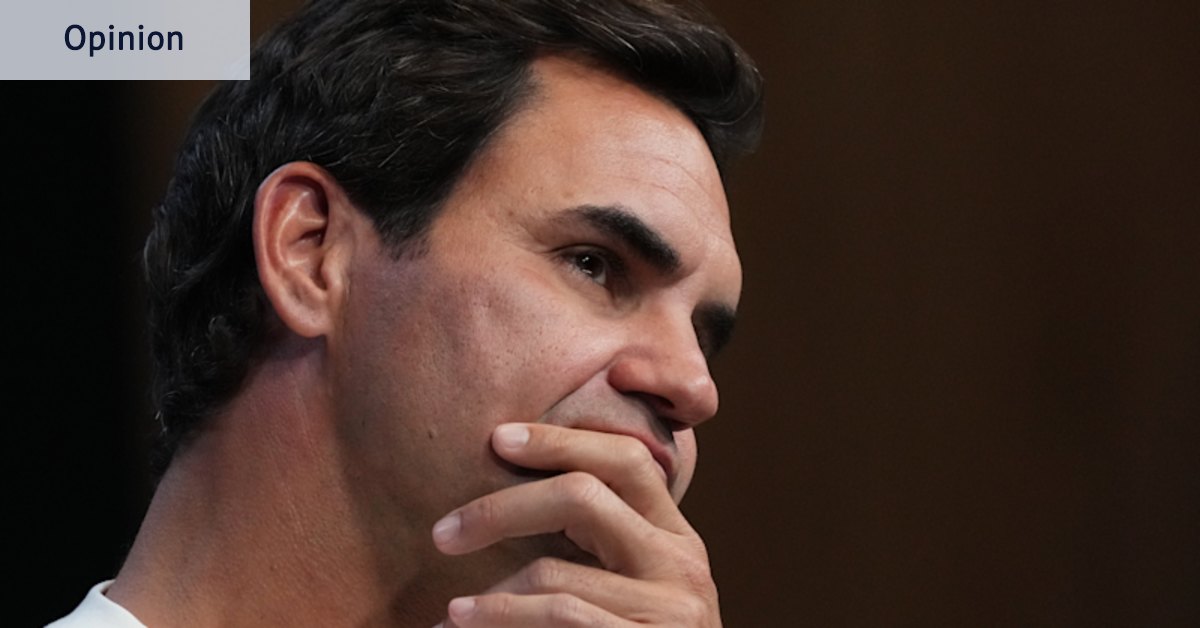
Roger Federer is another ex-champ as at home in the field of philosophy as he was on the court. In 2024, Federer delivered a commencement speech at Dartmouth College.
“Effortless is a myth,” he told the graduates. Nothing that looks effortless is achieved without enormous effort behind the scenes. Talent matters, but it comes in many forms. “Discipline is a talent,” Federer said, “and so is patience.”
At the climax of his speech, Federer untethered a truly scorching piece of life advice. First, he went through some numbers. In his pro career, he’d played more than 1500 singles matches. He’d won almost 80 per cent of these. When you put all his matches together, Federer had played, over the course of his career, several hundred thousand points of tennis.
But now he had a challenge for the Dartmouth graduates. Guess what percentage of those points he’d won.
The answer? 54 per cent. The most sublime tennis player of all time lost almost as many points in his career as he won. “When you lose every second point, on average,” Federer expatiated, “you learn not to dwell on every shot.”
That sounds like the cue for a New Year’s resolution. I know it’s February. But January’s gone now, like a lost first set. So let’s look ahead, control what we can control, and spend the rest of 2026 heeding the hard-won wisdom of the tennis stars. “When you’re playing a point, it’s the most important thing in the world,” Federer tells us. “But when it’s behind you, it’s behind you.”
The Booklist is a weekly newsletter for book lovers from Jason Steger. Get it delivered every Friday.
You have reached your maximum number of saved items.
Remove items from your saved list to add more.