
You have reached your maximum number of saved items.
Remove items from your saved list to add more.
Save this article for later
Add articles to your saved list and come back to them anytime.
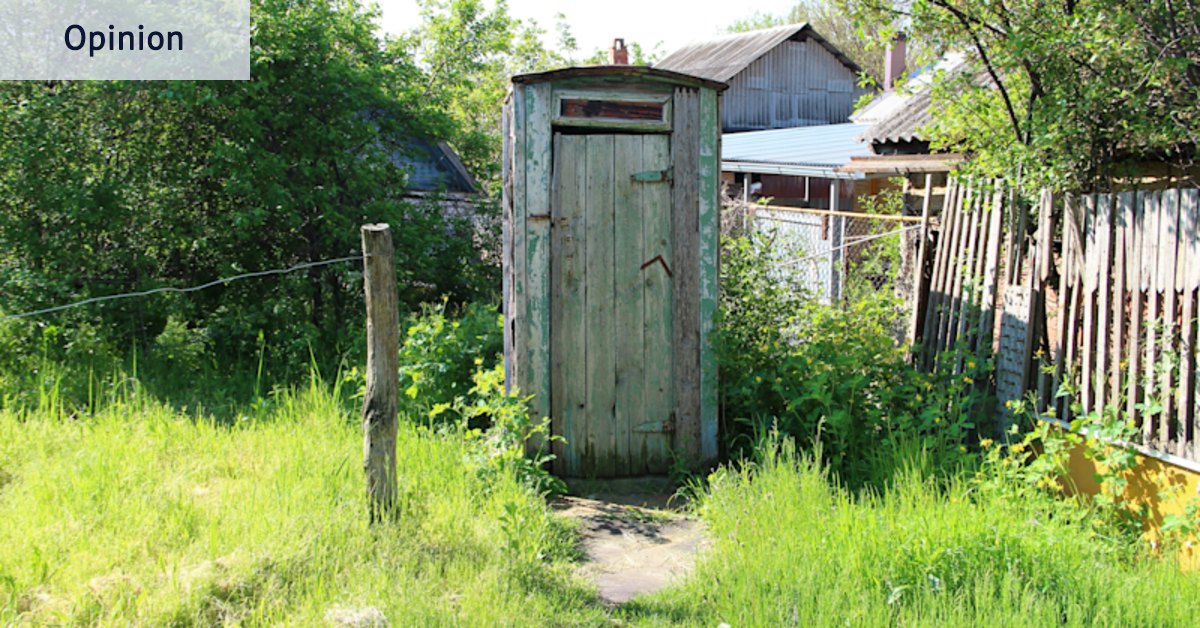
Someone should write a piece about the role of the outdoor dunny in Australian literature. What? No one else wants to do it? Oh well, it better be me. After all, there’s hardly a great Australian book that doesn’t feature exterior sanitation.
There’s the toilet in Tim Winton’s Cloudstreet, for instance, built on a catwalk hanging off the edge of the island. Winton calls it a “thunderbox” – “the seat was only eight feet above the water on a low tide, and on a high tide you were liable to experience what some well-travelled soul called nature’s bidet”.
Or, he says, “a shark might go for your heart the long way”, a phrase that really is far too vivid.
In My Brilliant Career, the toilet at Possum Gully is outside, as are the washing facilities – the morning ablutions are conducted using a leaky tin dish on a stool outside the kitchen door. It is a measure, in storytelling terms, of how far the author has fallen. The slab hut in Henry Lawson’s The Drover’s Wife offered no facilities, and neither did Dad and Dave’s accommodation in Steele Rudd’s On Our Selection. You had to go into the forbidding Australian bush. That was the point.
Meanwhile, in Ruth Park’s Harp in the South trilogy there’s a lavatory cistern with “a soprano wheeze”, a shared lavatory where you must wait your turn, and the dramatic moment where Hughie locks his brother in the outside dunny:
“Hughie?” Jer’s most charming, conciliatory voice.
“Yeah, what?”
“Let me out, mate, it’s bloody awful in here.”
The single best comic scene in Australian writing is probably the “night soil scene” in Clive James’ Unreliable Memoirs. It involves an outdoor dunny in suburban Kogarah in the 1940s, the dunny man running in to collect the tin of “refuse”, and Clive leaving his bicycle lying across the driveway. On the way in, the dunny man manages to successfully jump over the bike. On his way out, weighed down by the large tin of poo balanced on his shoulder, he is less successful in making the leap.
Clive hears the sound of “a dunny man running full tilt into a bicycle”. And then the “ping” of the lid coming off the can. Then the sound of a million flies making their way to Kogarah. As the book puts it: “They were coming from all over Australia.”
There’s a more sombre tone in David Malouf’s 12 Edmonstone Street, a memoir about growing up in Brisbane in the late 1930s. Most Brisbane dunnies were, at the time, set outside at the bottom of the yard, Malouf writes, featuring “a corrugated-iron roof swathed with bougainvillea or a loaded choko vine”. Once you shut the door, it was totally dark. Their own toilet had recently been shifted inside – but had “brought the dark in with it”. The writer describes what he calls “our cubbyhole of a lavatory”: “At the end of the storeroom passageway, behind a three-ply screen with no door, you sit in utter blackness on a split-seated throne that pinches.”
After all, there’s hardly a great Australian book that doesn’t feature exterior sanitation.
Toileting even warrants a mention in books about our political history. Cyril Pearl, in his Wild Men of Sydney, describes John Norton, politician, journalist and drunkard, becoming befuddled, towards the end of a long parliamentary session, as he searched unsuccessfully for a toilet. He ended up relieving himself on the floor of the Legislative Assembly. “He was dragged out by two constables to the accompaniment of salvos of ripe oaths and the crash of broken glass, the door of the Opposition room being shattered in the struggle”. As usual, the best scene in the book involves a toilet, or – in this case – the absence of one.
Australian songwriters have, of course, long seen the dramatic possibility of an unlit outdoor dunny, most obviously Slim Newton with Redback on the Toilet Seat: “There was a red-back on the toilet seat when I was there last night/I didn’t see him in the dark but boy I felt his bite.”
By the time the song was a hit, the outdoor dunny had – in most places – begun its way up the back path, heading towards the house. For a year or two, it sometimes perched on a corner of the back veranda before making its way into the home.
That shift was recorded by the novelist Frank Hardy in his book of yarns, Great Australian Legends. He tells the story of a bloke who hit it rich. He asks his wife if she wants anything. She nominates one of those newfangled backyard barbeques, and it is duly installed.
A year later, the money keeps rolling in, and he needs to spend more. Again, he asks his wife. This time, she nominates one of those newfangled inside toilets, which is duly installed.
Later, at the pub, the bloke’s friends ask him if it makes a difference being rich.
“Not really,” he says, “I used to eat in the house, and the toilet was in the backyard. Now I eat in the backyard, and the toilet is in the house.” The story concludes that it makes little difference to be rich.
As for my own conclusion? When it comes to portraying the outdoor dunny, Australian writers have always found themselves flushed with success.
Get a weekly wrap of views that will challenge, champion and inform your own. Sign up for our Opinion newsletter.
You have reached your maximum number of saved items.
Remove items from your saved list to add more.