
You have reached your maximum number of saved items.
Remove items from your saved list to add more.
Save this article for later
Add articles to your saved list and come back to them anytime.
A sequinned purple and silver top with a low-cut neckline can be expected at a Dior runway show, along with puffy floral capes, and knitted dresses.
The clothing confusion begins when you realise that its men’s fashion week in Paris.
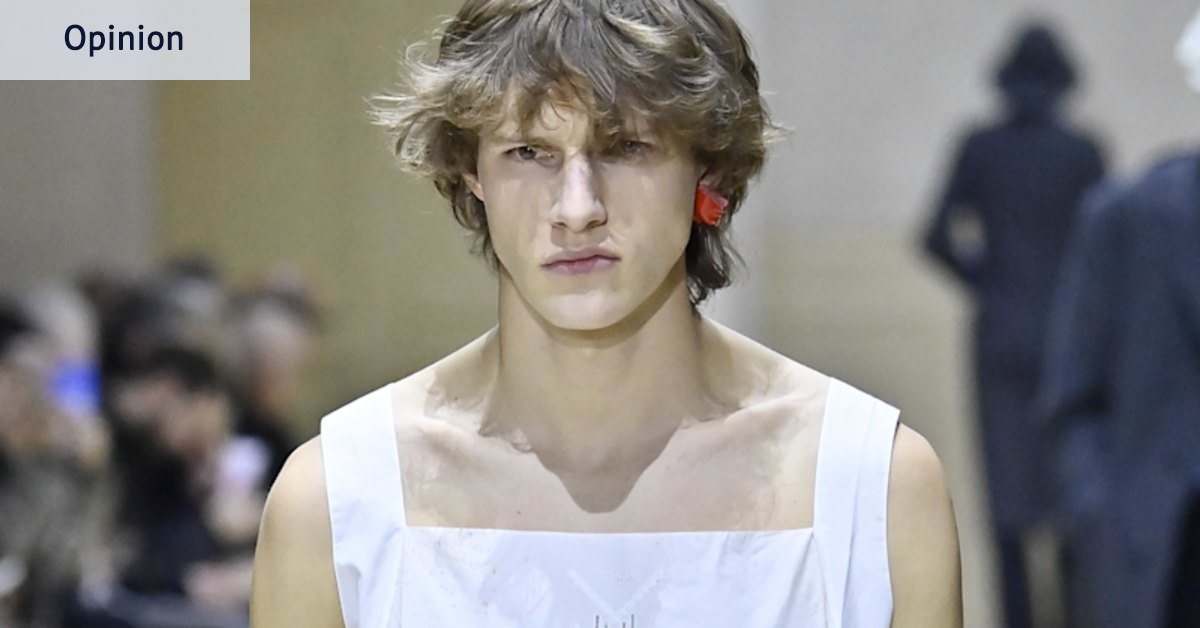
Models, built like gently muscled pipe cleaners, should give the game away, but looking at the clothes, it’s unclear whether the menswear shows are for female or male customers.
Celebrities such as Jacob Elordi, Josh O’Connor and A$AP Rocky manage to eloquently and elegantly speak to menswear trends on the red carpet, but something is getting lost in translation on the runway. Who is buying the fluffy pink scarf on the Feng Chang runway, the wrap skirts at Dior and the white square neck cotton tops worn with chunky red earrings at Prada?
These beautiful pieces look ready to be championed by women and fashion-forward members of the LGBTQ community such as Troye Sivan, Billy Porter and Colman Domingo, but the broader male consumer is being left behind.
The number of female models on the runway in Giorgio Armani suits, Dsquared2 distressed denim and Auralee plaid shirts at adds to the co-ed confusion.
This is not the time to give up on the majority of male shoppers. A study by Italian fashion industry group Altagamma shows that the number of luxury consumers shrunk to about 340 million people in 2025 from 400 million people in 2022.
If anyone can bring millions of men back its fashion hot property Jonathan Anderson, who reinvented Spanish brand Loewe. It’s early days for Anderson at Dior but at his second menswear runway show this week, Monsieur Dior looks an awful lot like mademoiselle.
Male models wearing Bar jackets, a womenswear staple introduced by Christian Dior in 1947, and full skirts, appear dressed for female customers.
Louche wide lapel grey flannel suits, hybrid sailor and cargo jeans and whimsical polo shirts, with or without epaulettes, offered some relief and shouldn’t confuse store staff wondering where to hang them when they arrive in boutiques this year.
Prada’s trench coats, with contrasting cropped ponchos, forest green coats and narrow double-breasted suits were also clearly for the boys.
Unfortunately, compared to the excitement and execution of more female-friendly pieces, the masculine clothing came up short. At Dolce & Gabbana, Louis Vuitton and Zegna, silhouettes, suiting and separates suffered from a case of aesthetic arrested development.
If we can’t find a happy medium, where menswear shows generate excitement, without relying on female, non-binary and LGBTQ customers, why have them?
This might be why Alexander McQueen’s creative director, Sarah Burton, has removed menswear from all runway shows, Gucci’s shows now combine menswear and womenswear, and luxury labels continue to drop from the men’s fashion week calendar.
It’s becoming increasingly clear why London Menswear Fashion Week was cancelled last year.
Clothes don’t have a gender, but it would be great for a man to have more exciting options, other than a sequin top and full skirt, to wear to the office on Monday.
Make the most of your health, relationships, fitness and nutrition with our Live Well newsletter. Get it in your inbox every Monday.
You have reached your maximum number of saved items.
Remove items from your saved list to add more.